Top Fully Funded Japan Scholarships: Nippon Foundation
皆さん、こんにちは!(Hello everyone!)
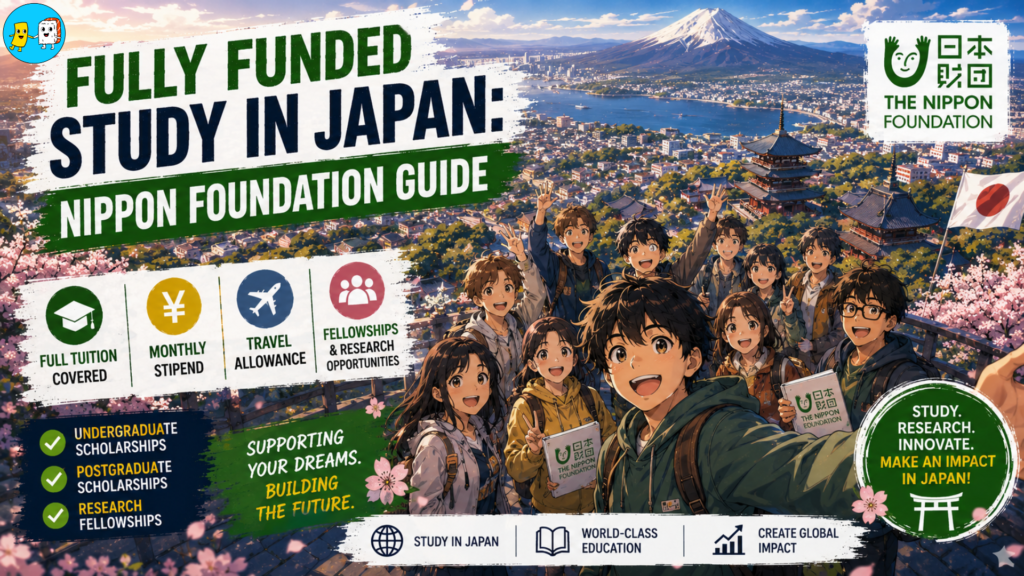
Akash here from Indori in Japan. If you’ve been dreaming about studying, doing research, or building a career in Japan, you already know the real hurdle: money. Most people jump straight to the MEXT scholarship, and fair enough, it’s the famous one. But there’s another giant in Japanese education funding that a lot of applicants miss entirely: The Nippon Foundation.

The Nippon Foundation is Asia’s largest philanthropic grantmaker, based in Tokyo. Over about 40 years it has funded roughly 40 different scholarship programs and supported more than 40,000 scholars across 100-plus countries. Whether you’re into intensive Japanese, public policy in Central Asia, ocean governance, seabed mapping, or international law, there’s probably a track for it.
Before you go hunting for a form, here’s the one thing that trips everyone up: The Nippon Foundation does not take direct applications from students at its Tokyo headquarters.
It works differently from a government ministry. The foundation runs a decentralised model: it hands large grants to partner universities, research institutes, and international organisations, and those partners handle the recruiting, screening, and selection. So you never apply to the foundation itself. You apply to whichever partner runs the program you want.
Why does Japan pour money into this? Partly the same demographic story as everything else, a shrinking young population, but also because the country runs on international collaboration and long-term networks. Training bright people from around the world builds goodwill and helps tackle shared problems in environmental science, law, public health, and education. Self-interest and generosity at the same time, which is usually how these things work.
What the money actually covers
Because these programs run through different partners, the exact package varies. But across the board, the coverage is generous. Here’s the shape of it.
Tuition and fees
Grad school or postdoc research at a top university can run tens of thousands of dollars a year. Nippon Foundation-backed programs wipe that out. The grants flow from the foundation to the host institution and cover 100 per cent of your entrance exam fees, matriculation charges, annual tuition, and lab or facility fees for your whole program. Whether you’re at the Inter-University Center in Yokohama, the University of Tsukuba, or ITLOS in Germany, tuition is handled.
The monthly stipend
The point of a stipend is that you focus on your thesis instead of doing rent maths every week. These programs pay a monthly living allowance scaled to where you’re based. Fellows in the GEBCO ocean mapping program at the University of New Hampshire, for example, get an annual living allowance of around US$39,400. Scholars based in Japan get monthly stipends that comfortably cover a private apartment, utilities, food, study materials, and local transport.
Flights and healthcare
Moving across the world shouldn’t drain your account before you even start. Most of these fellowships include round-trip economy airfare between your home country and the host university, at the start and again at the end. Health insurance is arranged too, either through Japan’s National Health Insurance or through international medical cover, so you’re protected against medical and emergency costs the whole time.
Which programs you can apply to
This is the part that surprises people: there are dozens of tracks, and they’re wildly different. Here are the main ones, grouped by type.
Programs in Japan and Eurasia
The Nippon Foundation Nikkei Scholarship.
Run by the Association of Nikkei & Japanese Abroad, this one (“Dream Come True Project”) is for young Japanese descendants (Nikkei) across Latin America and Asia who have concrete plans to connect their home country with Japan or lift their local community. What makes it unusual is the total freedom in what you study. You’re not boxed into a major, and you can enrol anywhere from a vocational college (Senmon Gakko) to a PhD program. Current scholars are doing medicine, engineering, international relations, design, veterinary science, culinary arts, fashion, Okinawan dance, even traditional acupuncture. Funding can run up to five years, and alongside your studies you join four leadership seminars a year and community projects like coastal cleanups under the Umi-to-Nippon Project.
Nippon Foundation Fellows Program at the Inter-University Center (IUC).
Based in Yokohama, this is a 10-month intensive Japanese program for high-achievers whose careers will centre on Japan, think academia, business, diplomacy, government, journalism, law, or translation. You need to be a citizen or legal resident of the US, Canada, Europe, South America, Australia, or New Zealand, with a bachelor’s before you start, and PhD candidates get preference. It takes up to 20 fellows a year, with full tuition and a monthly allowance, and you present your research in Japanese at twice-yearly mini-conferences.
Central Asia-Japan Human Resource Development Project (NipCA).
Hosted at the University of Tsukuba, NipCA gives graduate education to students from five Central Asian countries (Kazakhstan, Kyrgyzstan, Tajikistan, Turkmenistan, Uzbekistan) and two Caucasus ones (Azerbaijan, Georgia). It’s aimed at people who’ll go home and solve regional problems in line with the UN SDGs. It covers 18-month master’s degrees (like the Master of Public Health) and 3-year doctorates in public policy and health sciences, with full tuition, stipends, and travel, plus internships in Hokkaido and fieldwork back in Central Asia.
Sylff and NF-JLEP.
The Ryoichi Sasakawa Young Leaders Fellowship Fund (Sylff), established in 1987 and run by the Tokyo Foundation for Policy Research, provides US$1 million endowments to 69 universities in 44 countries, including Ritsumeikan Asia Pacific University and Keio in Japan. It funds graduate fellowships in the humanities and social sciences, and fellows can also apply for research grants and social-action grants of up to US$10,000 each. Running alongside it, the NF-JLEP fund endows 11 universities in six countries to support students and teachers of Japanese, with research grants and a two-week study tour to Japan for schoolteachers.
Global maritime and ocean governance fellowships
The Nippon Foundation is one of the biggest non-government backers of ocean governance and marine science anywhere, so this is a whole category of its own.
WMU Sasakawa Fellowship.
At the World Maritime University in Malmö, Sweden, a 14-month MSc in Maritime Affairs for up to 35 professionals a year, with priority for developing countries. Full tuition, accommodation, stipend, and field trips.
ITLOS Capacity Building Programme.
At the International Tribunal for the Law of the Sea in Hamburg, a 9-month program training seven junior-to-mid-level officials or legal researchers a year in dispute settlement under UNCLOS. Includes a studio apartment, stipend, travel, insurance, and German lessons.
UN-Nippon Foundation DOALOS Fellowship.
Run by the UN Division for Ocean Affairs and the Law of the Sea in New York, a 9-month program: three months of advanced training at UN Headquarters, then six months of research at a host institute. Built for mid-level officials from developing states working on ocean policy.
Nippon Foundation / GEBCO Ocean Mapping Program.
At the University of New Hampshire, a 12-month graduate certificate in ocean mapping for six scientists a year, feeding the global Seabed 2030 project. Full tuition, roughly US$39,400 stipend, computing kit, and funding for research cruises.
NF-IMLI Scholarship.
At the IMO International Maritime Law Institute in Malta, a 9-month program training 15 legal professionals a year in maritime and marine-environmental law.
Nippon Foundation Ocean Nexus.
Started in 2019, offering 2-year postdoc fellowships (13 a year) on ocean equity: social justice, climate adaptation, and resource access for coastal communities.
Who qualifies
Since each program is run by a different partner, the exact rules depend on the track. But most active programs share a baseline.
You’ll need the right academic credentials: a completed bachelor’s for master’s or certificate tracks, or a master’s for PhD tracks, from an accredited university, with a solid record. Some programs require a specific background, like Nikkei ancestry for the Nikkei Scholarship, Central Asian or Caucasus citizenship for NipCA, or citizenship of a developing nation for the DOALOS and ITLOS fellowships. Age brackets vary; the professional capacity-building programs like ITLOS and DOALOS usually want applicants between 25 and 40.
Language depends on the track too. English-taught programs (GEBCO, WMU, ITLOS, DOALOS) want TOEFL or IELTS scores, while the Japanese-language tracks like IUC Yokohama expect prior intensive Japanese study. And for the professional fellowships, you’ll generally need an official nomination letter from your home government ministry, maritime agency, or research institute confirming the training supports your country’s development.
Who's excluded
A few things rule you out. Applying directly to the Tokyo HQ gets you an instant rejection, since headquarters doesn’t process individual applications. Active military personnel aren’t eligible for the legal and international fellowship tracks. You can’t double-dip, so if you already hold full funding from MEXT, your home government, or another major foundation, you can’t hold a Nippon Foundation fellowship at the same time. And for programs that require you to return home and serve (DOALOS, ITLOS, the Deaf Leadership tracks), being unwilling to go back rules you out.
How to apply, step by step
The application lives with the partner, not the foundation, so the process is really about picking the right partner and following their rules. Five stages.
Stage 1: choose your track and check eligibility. Before any portal, work out which partner runs your field: IUC Yokohama for Japanese, Tsukuba for Central Asian public policy, UN DOALOS for ocean governance, and so on. Read that partner’s specific rules, age cutoffs, and regional requirements carefully.
Stage 2: build your dossier and research proposal. Gather your transcripts, degree certificates, test scores, recommendation letters, and a medical certificate. For graduate and research fellowships, write a clear research proposal showing how your plan tackles a real problem and fits the host institute’s strengths.
Stage 3: apply directly to the managing partner. Submit through that partner’s own admissions portal, and watch the deadlines, because they’re all different. The Nikkei Scholarship runs May to July, GEBCO closes in early spring, and ITLOS collects applications between January and March.
Stage 4: screening and interview. The partner’s committee reviews the files, and shortlisted candidates get an online video interview covering academic readiness, language, and how committed you are to your research.
Stage 5: award, visa, and onboarding. Successful candidates get a formal award package from the host, then sort out the student or scholar visa at their local embassy, arrange travel, and are automatically enrolled in The Nippon Foundation Scholars Association on arrival.
The key numbers at a glance
| Program | Managing partner & location | Who it's for | Duration | Coverage | Intake |
|---|---|---|---|---|---|
| Nikkei Scholarship | Association of Nikkei & Japanese Abroad (Japan) | Young Nikkei descendants, Latin America & Asia | Up to 5 years (vocational to PhD) | Full tuition, stipend, seminars, travel | ~148 supported |
| IUC Fellows Program | Inter-University Center, Yokohama | Graduate scholars (US, Canada, Europe, S. America, Aus, NZ) | 10 months (advanced Japanese) | Full tuition, monthly stipend | 20/year |
| NipCA Project | University of Tsukuba | Central Asia (5 states) & Caucasus (2) | 18 months (MA) / 3 years (PhD) | Full tuition, stipend, internships, travel | Cohort-based |
| WMU Sasakawa | World Maritime University, Malmö | Maritime professionals, developing countries | 14 months (MSc Maritime Affairs) | Full tuition, accommodation, stipend, trips | 35/year |
| UN-NF DOALOS | UN DOALOS, New York | Mid-level officials, developing states (25-40) | 9 months (3m UN HQ + 6m host) | Full tuition, stipend, UN training, travel | 14/year |
| GEBCO Ocean Mapping | University of New Hampshire | Oceanographers & hydrographers, global | 12 months (postgrad certificate) | Full tuition, ~$39,400 stipend, kit, travel | 6/year |
| ITLOS Capacity Building | ITLOS, Hamburg | Junior/mid-level legal officials (25-40) | 9 months (UNCLOS dispute settlement) | Full tuition, apartment, stipend, insurance | 7/year |
FAQs: Your Questions Answered
Q1. Can I send my application straight to the Tokyo office?
No, and this is the mistake that costs people. The Nippon Foundation is purely a grantmaker and doesn’t process individual applications. Every program is run by a host partner, whether that’s the University of Tsukuba, IUC Yokohama, or UN DOALOS. Pick your program and apply through that partner’s own website.
Q2. Do I need to be fluent in Japanese?
Not for everything. It depends on the track. Programs like IUC Yokohama expect prior Japanese study, but the international ocean and legal programs, GEBCO, ITLOS, WMU Sasakawa, and DOALOS, run entirely in English and just want an English test score.
Q3. How is this different from MEXT?
MEXT is government money, run by Japan’s education ministry and its embassies, and it covers general degrees across all fields. Nippon Foundation scholarships are private, run through specialised university and organisation partnerships, and they target specific sectors: maritime law, ocean mapping, Nikkei leadership, Japanese studies, public health.
Q4. What happens after I graduate? What's TNFSA?
In 2020 the foundation launched The Nippon Foundation Scholars Association (TNFSA) to link graduates across all 40 programs. When you finish, you automatically join a network of 40,000 fellows, with alumni gatherings, mentorship, cross-disciplinary collaboration, and seed grants for small social-action projects.
Q5. Can I hold another scholarship or job at the same time?
No. These fellowships are meant to fully cover your tuition, housing, and living costs, so partners don’t allow a second full scholarship or tuition waiver on top. Part-time research work on campus may be fine depending on the host’s rules and your visa, but full-time outside employment isn’t allowed during the fellowship.
Conclusion: worth the extra digging
A fully funded scholarship is one of the best moves you can make toward an international career, and the Nippon Foundation’s spread-out system opens doors that most applicants never find, simply because they don’t know where to look. Go past the standard university route, target the right partner institution, and there’s real opportunity here across higher education, ocean science, public policy, and cross-cultural leadership.
So take your time with the partner websites, double-check the eligibility rules, and write a proposal that clearly ties your goals to the foundation’s mission.
And if you’d like a hand with the research proposal, your academic dossier, or the visa process, our team at Indori in Japan is here for it. You can book a 1-on-1 session, use our Japanese learning resources, and follow our socials to catch upcoming scholarship cycles and student-life tips. Build your file carefully, keep going, and we hope to see you in Japan.
✍️ Bonus: Need Help Starting?
✅ Job hunting tips and real listings for foreigners in Japan
✅ Visa guidance made simple—no confusing search
✅ Resume & cover letter templates (Japanese & English formats)
✅ Life in Japan explained — from rent to ramen
✅ Travel guides & city recommendations for every kind of explorer
✅ Work culture insights to help you adjust and thrive