Ajinomoto Scholarship Foundation Program: Fully Funded Master's Degree in Japan for Indian STEM Graduates
皆さん、こんにちは!(Hello everyone!)
The dream of pursuing higher education in Japan has captured the imagination of thousands of Indian graduates. However, the financial challenges associated with tuition, housing, and relocation often stand as major barriers. Through the Indori in Japan platform, Aakash has spent years guiding Indian students on how to navigate the academic and cultural landscape of the Land of the Rising Sun. One of the most powerful, life-altering pathways available to Indian STEM students is the prestigious fully funded Ajinomoto Scholarship.
Aakash highlights that this program is a gold mine for anyone passionate about food science, human nutrition, green engineering, biochemistry, and sustainability. Sponsored by the world-famous Ajinomoto Group, this scholarship completely removes the financial stress of studying abroad, allowing students to focus on pioneering research at Japan’s most elite national and private universities. This comprehensive guide details every facet of the scholarship program, outlining the required preparation for the application window that opens in August and closes in October.
Quick Details of the Ajinomoto Scholarship Program
To provide an immediate and structured overview of this prestigious academic opportunity, the core statistics and parameters of the program are summarized in the table below.
| Parameter | Key Program Statistics & Information |
|---|---|
| Scholarship Name | Ajinomoto Scholarship for Students from Overseas |
| Sponsoring Body | The Ajinomoto Scholarship Foundation / Ajinomoto Group |
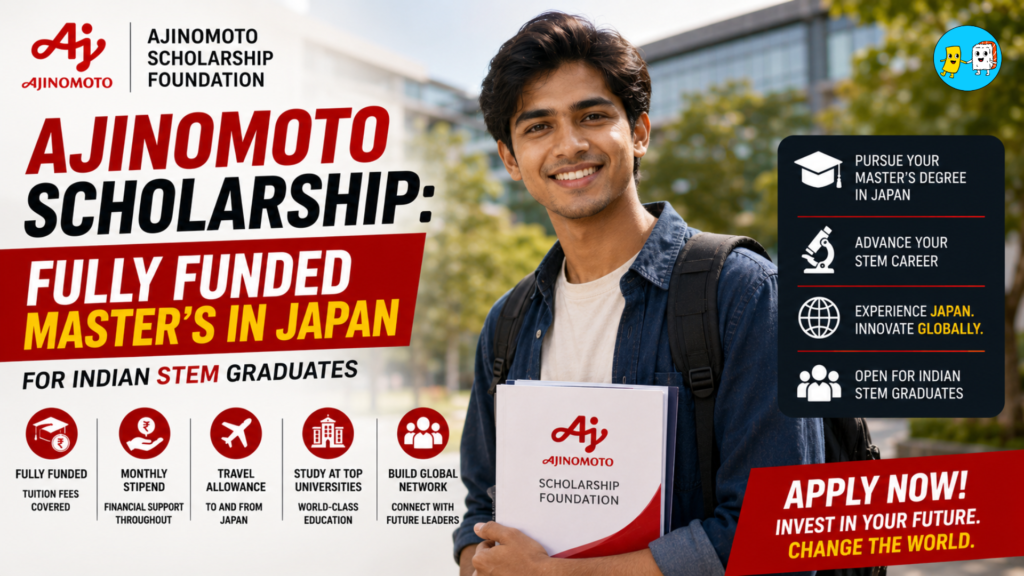
| Financial Coverage | Fully Funded (Stipend, Tuition Waiver, Admission Fees, Airfare) |
| Target Audience | Outstanding STEM graduates from India and other selected nations |
| Eligible Fields of Study | Food Science, Human Nutrition, Chemistry, Engineering, and Sustainability |
| Scholarship Duration | 2 Years (Up to 3 years including the optional Research Student phase) |
| Monthly Living Stipend | ¥150,000 (Research Phase) to ¥180,000 (Master's Course Phase) |
| Application Opens | August |
| Application Deadline | October |
| Host Universities | UTokyo, Kyoto, Nagoya, Science Tokyo, Waseda, Ochanomizu, and Kagawa Nutrition |
| Official Application Link | Ajinomoto Scholarship 2026 |
Why Choose Japan and the Ajinomoto Scholarship 2026?
Akash regularly emphasises that Japan is currently at the absolute forefront of global innovation in biochemistry, functional food development, and green technologies. The country is grappling with a super-ageing society, which has driven massive national and corporate investment into preventative medicine, clinical nutrition, and metabolic health. At the same time, global environmental challenges have pushed industries to develop sustainable food packaging, bioplastics, and carbon-neutral manufacturing processes.
The Ajinomoto Group is a global leader in “AminoScience”. Through its corporate philosophy of Creating Shared Value, the company aims to extend the healthy life expectancy of one billion people and reduce its environmental impact by 50% by the year 2030. The Ajinomoto Scholarship Foundation was created to cultivate the next generation of scientific leaders who will drive these innovations.
According to the Indori in Japan team, this scholarship is highly valued because it represents a direct link between academia and high-tech industries. Scholars do not just study in isolated labs; they are exposed to the cutting-edge R&D infrastructure of a global food and chemical giant. For Indian students, this exposure is invaluable, opening doors to careers in global research, biopharmaceuticals, and sustainable engineering.
Detailed Financial Benefits of the Program
The financial security offered by this program is designed to provide complete peace of mind. Aakash frequently notes that the high cost of living in major Japanese cities can be intimidating for Indian middle-class families. The Ajinomoto Scholarship fully mitigates this concern by providing a comprehensive financial package.
1. Robust Monthly Living Allowance
The foundation provides a structured monthly stipend tailored to the student’s academic phase. During the initial period, when the scholar is admitted as a Postgraduate International Research Student, they receive ¥150,000 per month. This phase allows the student to adjust to the laboratory, learn basic Japanese, and prepare for the formal graduate school entrance exam. Once the student formally passes the examination and enrolls as a regular Master’s Course Student, the monthly stipend rises to ¥180,000. This allowance is among the highest offered by any private foundation in Japan, ensuring comfortable living, nutritious food, and ample savings.
2. Full Coverage of Academic Fees
The scholarship takes complete charge of the heavy financial load associated with university fees. The foundation pays for the university entrance examination fees, the formal admission/matriculation fees, and the complete tuition fees for the entire duration of the two-to-three-year program.
3. International Air Travel Support
To make the transition completely seamless, the foundation covers the cost of international transit. Scholars are provided with a direct, economy-class one-way air ticket from India to Japan at the beginning of their scholarship. Upon successful completion of their Master’s degree, a return air ticket is also provided to fly back to India.
4. Comprehensive Pre-Departure and Language Support
The foundation covers mandatory medical and psychological examinations before departure. Furthermore, to ensure that the language barrier does not impede the student’s research or daily life, the program sponsors intensive Japanese language training. This training helps students build conversational fluency and confidence before they step into their research laboratories.
Elite Host Universities in Japan
The scholarship is restricted to seven of Japan’s most prestigious institutions, each representing the pinnacle of global scientific research. Aakash points out that graduating from any of these universities immediately elevates a student’s profile in the global job market:
- The University of Tokyo (UTokyo): Consistently ranked as the top university in Japan, UTokyo boasts state-of-the-art laboratory equipment and a massive network of international researchers.
- Kyoto University: World-renowned for its emphasis on creative, independent research, Kyoto University has produced numerous Nobel laureates in chemistry and medicine.
- Institute of Science Tokyo (formerly Tokyo Institute of Technology): A legendary institution for engineering and material sciences, perfect for students focusing on green technology, bio-plastics, and sustainable manufacturing processes.
- Nagoya University: Known for its highly collaborative research environment and its strong ties to leading Japanese automotive, chemical, and food industries.
- Waseda University: One of the most famous private universities in Japan, offering dynamic, English-taught graduate programs in advanced science and engineering.
- Ochanomizu University: Highly respected for its focus on human ecology, advanced life sciences, and development studies.
- Kagawa Nutrition University (Japan Nutrition University): The absolute gold standard for specialized nutritional research, metabolic health studies, and clinical dietetics.
Academic Eligibility Criteria for Indian Students
The selection process for the Ajinomoto Scholarship is highly competitive. To ensure that only the most dedicated and academically brilliant minds are selected, the foundation enforces strict eligibility rules.
Indian applicants must hold Indian citizenship and must be residing in India at the time of application. Students who are already living, studying, or working in Japan are not eligible to apply under the primary overseas track. Academically, candidates must have completed, or be on track to complete, a minimum of 15 years of formal education before March of the enrollment year. This criteria fits perfectly with the Indian education system, accommodating students with a four-year B.Tech or B.Sc. Agriculture degree, or those who have completed a three-year bachelor’s degree followed by the first year of a master’s program.
Furthermore, applicants must demonstrate exceptional academic performance, typically ranking in the top 5% of their graduating class, or possessing a minimum GPA of 3.5 out of 4.0 (or its equivalent percentage and CGPA scale in Indian universities). The program is designed for young researchers, which is why candidates must be under the age of 30 as of April 1 of the enrollment year. Certain specialised bilateral agreements may allow candidates up to 35, but under 30 remains the standard target for the competitive international student pool.
Additionally, candidates must show a genuine need for financial assistance to support their higher studies in Japan. The applicant must not be receiving any other major scholarships or financial grants from the Japanese government, foreign governments, or other private foundations. Finally, because living and working in a foreign country requires immense grit, candidates must be in excellent physical and mental health, with a strong, demonstrable motivation to learn the Japanese language and assimilate into the local culture.
Required Application Documents Checklist
Akash always reminds students that a single missing or poorly compiled document can lead to immediate rejection. Therefore, Indian applicants must prepare their portfolios with extreme precision. The following documents must be prepared in English or accompanied by an official, attested Japanese translation :
- Official Scholarship Application Form: The prescribed Form 1 must be filled out completely, with a high-resolution professional passport-sized photograph attached.
- Current Research and Detailed Future Study Plan: Form 2 requires a comprehensive, well-structured description of the candidate’s current scientific projects and a highly detailed proposal of the research they plan to execute in Japan. This study plan is the single most critical factor in the evaluation process.
- Attested Letters of Recommendation: Applicants must submit at least two letters of recommendation from their university president, college dean, or academic research advisor. These letters must be printed on official university letterhead, signed, and enclosed in sealed envelopes with the recommender’s signature across the flap.
- Official Academic Transcripts and Certificates: Certified true copies of graduation certificates and semester-wise transcripts from all post-secondary institutions attended must be submitted.
- Comprehensive Financial Documents: To substantiate financial need, applicants must submit official documents, such as the latest Income Tax Returns (ITR) of their parents, official salary certificates, or a local government-issued certificate of financial standing.
- Language Proficiency Test Scores: Certified copies of English proficiency test scores (such as TOEFL or IELTS) or Japanese proficiency scores (such as JLPT certificates) must be included if required by the target university.
- Identity Verification: A clear, high-quality photocopy of the applicant’s valid Indian passport (specifically the photo page and personal information page) is required.
Step-by-Step Selection and Matching Timeline
The pathway to securing the Ajinomoto Scholarship involves a highly structured, multi-layered selection process. Aakash advises Indian students to start planning their strategies at least a year in advance. The formal timeline operates as follows:
Phase 1: University and Laboratory Outreach (June to July)
Before the application window opens in August, proactive candidates must research the seven participating universities. They must identify specific laboratories and professors whose current research aligns with their academic background. The candidate should send a polite, well-structured email containing their CV and a draft of their research plan to the target professor. Securing an informal acceptance or a positive response from a Japanese supervisor before submitting the formal application is a massive advantage.
Phase 2: Application Window and Submission (August to October)
The formal application process opens in August. Applicants must compile all required forms, research plans, recommendations, and financial papers. The entire, sealed application package must be submitted through the designated channels before the final deadline in October. Late or incomplete submissions are rejected immediately, with no exceptions.
Phase 3: Primary Document Screening (November to December)
The selection committee, consisting of academic experts and representatives from the Ajinomoto Group, conducts a rigorous review of all submitted portfolios. They evaluate the applicant’s academic standing, financial need, and the scientific viability of the research proposal.
Phase 4: Secondary Interviews (January to March)
Shortlisted candidates are invited to an intensive technical and personal interview. Conducted entirely in English (or Japanese, if the candidate is fluent), this panel interview evaluates the applicant’s scientific depth, communication skills, motivation, and adaptability to life in Japan.
Phase 5: Matching and Final Enrollment (April to June)
Successfully nominated candidates work closely with the foundation to secure their formal admission letters and certificate of eligibility from their chosen graduate schools. Once the university confirms the match and the foundation chairman signs the scholarship pledge, the candidate is officially declared an Ajinomoto Scholar.
Phase 6: Visa Processing and Relocation (July to September)
The scholar undergoes medical examinations, processes their student visa at the Japanese embassy, and participates in sponsored language training. The scholar then boards their flight to Japan, ready to begin their new academic life.
Proactive Strategies and Practical Tips from Akash
To help Indian applicants stand out in this highly competitive pool, the Indori in Japan platform offers several strategic recommendations:
- Customise the Research Proposal to Match Corporate Goals: A generic research plan will not succeed. The study plan must address a real-world problem and clearly show how it aligns with the Ajinomoto Group’s focus on sustainability, green chemistry, bio-plastics, or health optimisation. Connecting the research to the United Nations Sustainable Development Goals (SDGs) immediately makes the proposal highly compelling.
- Highlight Laboratory Adaptability and Independence: Japanese laboratories, known as “Kenza,” operate like highly structured teams. In the personal statement, the applicant should highlight their hands-on laboratory experience, their familiarity with advanced scientific instruments, and their ability to work independently while remaining a supportive team player.
- Secure, Attested and Well-Structured Recommendations: The letters of recommendation should not be generic. Aakash advises students to work with their professors to ensure the letters contain specific examples of the candidate’s problem-solving skills, laboratory competence, and resilience under academic pressure.
- Manage Indian Financial Documentation Early: Gathering certified true copies of parents’ Income Tax Returns, salary slips, or certificates of non-filing can take a lot of time in India. Proactive candidates must gather these documents well in advance of the October deadline.
Frequently Asked Questions (FAQs)
Q1. Can an Indian student apply directly to the Ajinomoto Scholarship Foundation?
No, the foundation does not accept direct, individual applications from students. Indian students must apply through a university recommendation process, where the international student office of their chosen Japanese university nominates them, or through the designated regional office of the Ajinomoto Group in their home region.
Q2. Is JLPT Japanese language proficiency mandatory at the time of application?
No, it is not mandatory for programs that are fully taught in English. However, the selection committee highly values candidates who have taken the initiative to learn basic Japanese. Having a JLPT N5 or N4 certification on the resume shows genuine motivation and cultural adaptability, giving the applicant a competitive edge.
Q3. Can this scholarship be held concurrently with the MEXT Scholarship?
No, the Ajinomoto Scholarship cannot be combined with the Japanese Government MEXT scholarship, the Interchange Association Japan (IAJ) scholarship, or any other major foreign government grants. If a student is selected for another major grant, they must choose one and decline the other.
Q4. What is the difference between the Research Student phase and the Master's Course phase?
In the Japanese academic system, international students often spend their first six months to a year as non-degree-seeking “Research Students”. This transitional period allows them to adapt to the lab and prepare for the formal graduate school entrance exam. The Ajinomoto Scholarship covers this phase with a stipend of ¥150,000 per month. Once the student passes the entrance exam and enrolls in the regular Master’s program, the stipend increases to ¥180,000 per month.
Q5. What are the common pitfalls that lead to the cancellation of the scholarship?
The scholarship can be suspended, canceled, or subjected to full repayment if a student provides false information on their application, takes an unapproved leave of absence, is subjected to university disciplinary action, or fails to pass the graduate entrance exam within one year of arriving in Japan. Maintaining strong academic standing and adhering to university regulations is mandatory for the continuation of the grant.
Conclusion
The Ajinomoto Scholarship Foundation Program stands as one of the most generous and prestigious fully funded opportunities for Indian STEM graduates aiming to study in Japan. By removing all financial burdens, covering academic fees, and providing a highly competitive living stipend, this program allows brilliant young minds to focus entirely on their research at Japan’s top universities.
For Indian students, the key to success lies in proactive preparation. By identifying target laboratories early, crafting a highly specialized research proposal that aligns with green chemistry and sustainability goals, and preparing all financial and academic documents well in advance of the October deadline, candidates can turn their dream of studying in Japan into a reality. The Indori in Japan platform continues to support and guide Indian students along this exciting academic journey.
✍️ Bonus: Need Help Starting?
✅ Job hunting tips and real listings for foreigners in Japan
✅ Visa guidance made simple—no confusing search
✅ Resume & cover letter templates (Japanese & English formats)
✅ Life in Japan explained — from rent to ramen
✅ Travel guides & city recommendations for every kind of explorer
✅ Work culture insights to help you adjust and thrive