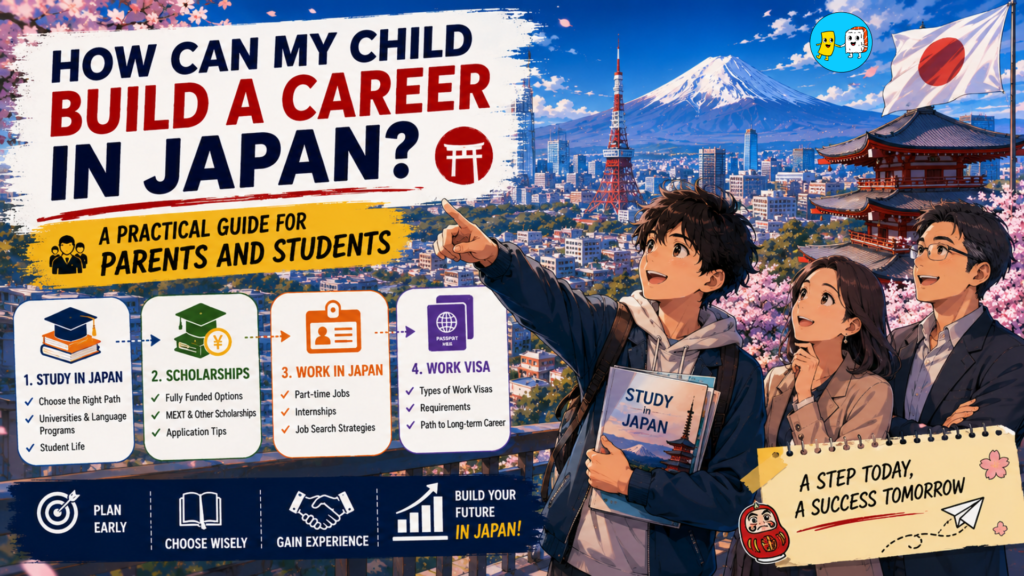
How can my child build a career in Japan? A practical guide for parents and students
皆さん、こんにちは!(Hello everyone!)
Almost every week, a parent asks me some version of this. Sometimes after a seminar in Tokyo, sometimes in my DMs, sometimes it’s a friend of a friend back home who heard I’ve built my life here. The wording changes, the worry doesn’t: “My son loves Japanese tech and culture.” “My daughter wants to study at a Japanese university.” “We want to help, but we have no idea where to start or how the visa system works.”

I’ve answered this in pieces for years, usually rushed, between meetings or over quick chats. So here’s the whole thing in one place.
One important caveat first. I’ve lived and worked in Japan for years and I’ve watched dozens of young people go through these exact routes, but I’m not a licensed immigration lawyer. Everything here comes from experience, not legal credentials. Rules, ministry guidelines, and university requirements change, so treat this as the lay of the land in 2026 and always confirm the specifics with the Immigration Services Agency of Japan, a qualified immigration professional, or the Japanese embassy before you commit money to anything.
The big picture is simple: Japan actually needs young international talent, and it has rebuilt its systems to bring them in.
Why Japan is actively recruiting global youth
To see why this is such an opening, look at the demographics. Japan’s birth rate is low and its workforce is shrinking. To stay a leader in tech, manufacturing, healthcare, and services, Japanese industry has to bring skilled people in from abroad. That’s not a favour, it’s a need, and it has changed the whole relationship between international talent and the Japanese job market. The government has built education and economic partnerships across Asia and beyond, opening direct channels for students, researchers, and technical workers.
You can see the response in three places. In higher education, the education ministry (MEXT) has pushed internationalisation hard: there are now more than 300 degree programs taught entirely in English. Big national names like the University of Tokyo, Waseda, and Kyushu run English-medium tracks, and so do sharp private schools like Toyo University and Shibaura Institute of Technology. In funding, there are MEXT scholarships and university tuition waivers. And in immigration, there’s a post-graduation job-hunting visa (Tokutei Katsudou) that gives graduates time to find work and convert to a standard work visa.
Tuition is the part that surprises Western parents most. It’s remarkably cheap next to North America, Western Europe, or Australia. MEXT sets a standard national-university tuition of ¥535,800 a year, plus a one-time admission fee of around ¥282,000. Even when a university uses its legal room to charge up to 20% more, like the University of Tokyo at ¥642,960 a year, you’re still paying a fraction of what a comparable degree costs elsewhere.
The five real routes into a career in Japan
There are five main pathways, and each has its own costs, language demands, and visa outcomes. Here’s how they actually work.
Pathway 1: The language school bridge
Enrolling in an accredited Japanese language school on a Student Visa is the most common way in. Programs usually run one to two years, taking you from basic grammar to business-level fluency.
On money and work, tuition at a decent Tokyo language school runs about ¥660,000 to ¥900,000 a year, before registration and materials. With a Student Visa you can get official part-time work permission and work up to 28 hours a week during term. That helps with living costs, but the real value is subtler: it forces you to speak actual Japanese in real shops and workplaces from month one.
There’s a genuine case for arriving young. Someone who lands at twenty absorbs the language and the unspoken stuff, workplace etiquette, reading the room (kuuki wo yomu), through total immersion. Someone who arrives at thirty-five with a job title and a family tends to learn it from the outside, in the gaps between meetings. The younger you come, the faster it goes in.
But here’s the catch nobody tells you upfront: a language school is a bridge, not a destination. Finishing one on its own does not qualify you for a work visa, and it does not get you the post-graduation job-hunting visa. You have to plan it as a step straight into a university, graduate school, or vocational college. If it dead-ends, it was mistimed.
Pathway 2: Direct admission to a Japanese university
You can apply straight from home to an undergraduate or graduate degree, either in a traditional Japanese-taught track or a modern English-taught one.
If your Japanese isn’t advanced yet, the English-taught degrees at places like Tokyo, Waseda, Kyushu, Toyo, and Shibaura let you start immediately. You do your major in English and take Japanese classes on the side.
This route matters for immigration reasons. A bachelor’s, master’s, or doctorate legally satisfies the academic requirement for a work visa. It also plugs you into Japan’s formal corporate recruitment process (Shuushoku Katsudou), and it makes you eligible for the Designated Activities job-hunting visa, which lets you stay one to two years after graduation specifically to look for work. That combination is the whole point.
Pathway 3: Vocational colleges (Senmon Gakko)
Vocational colleges run intensive two-year diploma programs built around practical, industry-ready skills rather than theory.
They cover things like software engineering, game design, animation, automotive tech, culinary arts, and hotel management, all hands-on. Graduates earn a Technical Associate Degree (Senmon-shi), which lets them convert their Student Visa into a work visa or take the job-hunting extension. One firm rule to know: immigration insists the job you’re hired for must closely match what you actually studied. This is the pathway where the degree-matching rule bites hardest, so choose the field carefully.
Pathway 4: MEXT scholarships and university recommendation
The Monbukagakusho (MEXT) scholarship, funded by the education ministry, is the gold standard for fully funded study. It covers admission fees, 100% of tuition, round-trip international flights, and a monthly living stipend.
There are two ways in, and they work differently.
The embassy recommendation channel goes through your local Japanese embassy. You sit written exams in subjects like maths and languages, then face interview rounds. Pass, and you get a First Screening Pass that lets you approach public universities for provisional admission.
The university recommendation (UR) channel skips the embassy exams. You apply straight to a university that holds MEXT slots, it assesses your file and research plan, and if it picks you, it nominates you to MEXT in Tokyo directly. One institution, one process.
A closer look: the APU MEXT UR pathway
Ritsumeikan Asia Pacific University (APU) in Beppu, Oita, is a clean example of how UR works for graduate students. About half its students and faculty come from more than 90 countries and regions.
The MEXT UR route at APU covers fully English-taught graduate programs in the Graduate School of Asia Pacific Studies (international relations, policy, development), the Graduate School of Management (the MBA), and doctoral study.
On money, awardees get a 100% waiver of admission and tuition fees through a mix of MEXT funding and APU’s own Tuition Reduction Scholarship. MEXT adds a monthly living allowance of ¥144,000 (about $960), which goes a long way in a regional city like Beppu, and pays round-trip economy airfare.
On eligibility, you need citizenship of a country with diplomatic ties to Japan, and you can’t hold Japanese nationality. There’s a minimum converted GPA of 2.30 on a 3.00 scale from your most recent institution, and a strict age rule: for the September 2027 intake you must have been born on or after 2 April 1992.
On language, since teaching is in English you need CEFR B2 or higher, on a test taken inside the valid window (for the 2027 cycle, on or after 15 March 2025). Accepted minimums include TOEFL iBT 80 (or 72 on some tracks), IELTS 6.0 (or 5.5 on some tracks), TOEIC L&R 780, or Cambridge FCE Grade B.
On timing, for a September intake the online window opens 1 September and closes 5 November the year before, with a ¥5,000 fee. APU reviews documents, calculates GPAs, and watches video interviews between November and January, issues offers and MEXT nominations in February or March, and final confirmation from Tokyo lands in late June, just before September arrival.
Pathway 5: Direct overseas recruitment
If you already hold a university degree and relevant experience, a Japanese company or a multinational in Tokyo can hire you directly.
Most foreign professionals here work under the Engineer/Specialist in Humanities/International Services visa. And there’s a rule you can’t get around: your degree major has to line up with the job. A Computer Science graduate walks into a software engineering visa. A Literature graduate offered a network engineering role gets rejected, unless they can document at least ten years of relevant industry experience. More on this below, because it catches people out constantly.
The pathways side by side
| Pathway | Best for | Example institutions | Tuition & fees (JPY) | Stipend or part-time earnings | Visa & extension | Key requirements |
|---|---|---|---|---|---|---|
| Language school | Total language immersion | Accredited institutes (Tokyo, Osaka, Fukuoka) | ¥660k-900k/yr plus fees | Part-time up to 28 hrs/wk (~¥100k-140k/mo) | Student Visa (1-2 yrs). No job-hunting extension | High school diploma; basic Japanese (JLPT N5 or ~150 hrs) |
| National university | Elite academic degrees | University of Tokyo, Kyushu | ¥535,800/yr (up to ¥642,960 at UTokyo); admission ~¥282k | Part-time 28 hrs/wk; merit waivers | Student Visa (2-4 yrs). Eligible for 1-2 yr job-hunting visa | Strong record; EJU or TOEFL/IELTS depending on track |
| Private university | English-taught tech or business majors | Waseda, Toyo, Shibaura | ¥800k-1.5M/yr; admission ~¥200k-300k | Part-time 28 hrs/wk; private scholarships | Student Visa (2-4 yrs). Eligible for 1-2 yr job-hunting visa | Standardised testing; English track needs TOEFL iBT 80+ or IELTS 6.0+ |
| Vocational (Senmon Gakko) | Practical, industry-ready skills | Accredited vocational colleges | ¥900k-1.3M/yr; admission ~¥150k-250k | Part-time 28 hrs/wk in approved sectors | Student Visa (2 yrs). Technical Associate Degree + job-hunting visa | JLPT N2; major must match the job |
| General MEXT | High-achieving scholars, any field | Public national universities | Fully waived | Stipend ¥117k-145k/mo; flights included | Student Visa (degree duration + prep year) | Top record; embassy written exams and interviews |
| APU MEXT UR | Outstanding grad applicants (MBA, Asia-Pacific) | Ritsumeikan APU (Beppu) | Fully waived | Stipend ¥144k/mo; economy airfare | Student Visa (2 yr MA / 3 yr PhD). Direct to work visa | GPA 2.30/3.00; CEFR B2 (TOEFL 80, IELTS 6.0); born on/after 2 Apr 1992 |
| Direct employment | Experienced professionals, technical grads | Multinationals & Japanese firms | N/A (employer sponsors) | Salary ~¥3.5M-8M+/yr | Engineer / Specialist in Humanities / Int'l Services | Degree matching the job, or 10+ yrs experience |
The immigration mechanics that actually trip people up
If you understand only a few things about Japanese immigration law, make it these, because they’re where plans quietly fall apart.
The degree-matching rule
When you apply for the Engineer/Specialist in Humanities/International Services visa, immigration officers read your official transcripts and check that your major supports the job.
A BSc in Computer Science plus a software engineering offer sails through. A Fine Arts degree plus a database administrator offer usually gets denied, however good your self-taught coding is, because the academic alignment isn’t there. The one escape hatch is documented proof of at least ten years of relevant professional experience. Plan your major around the career you want, not the other way round.
The job-hunting extension (Tokutei Katsudou)
Interviewing during your final year is hard, and plenty of graduates don’t have an offer in hand by the time they finish. So Japan offers a specific extension, the Designated Activities Visa for Job Hunting, to bridge that gap.
It’s open to graduates of accredited universities, graduate schools, and vocational colleges. It is not open to anyone who only did a language school, which is exactly why the language-school-as-a-bridge point matters so much. It’s issued for six months and renewable once, up to a year in general, and up to two years under certain university recommendation tracks. That’s your window to hit job fairs and run through interview cycles without your visa lapsing.
Part-time work rules (Shakushiki)
On a Student Visa you can’t legally work for pay until you get official part-time authorisation (Shakushiki). Once you have it, the cap is strict: 28 hours a week during term, rising to 8 hours a day (40 a week) during official holidays. Blow past those limits and you’re risking visa-renewal refusals or deportation. This is not a rule to test.
FAQs: Your Questions Answered
Q1. How is MEXT University Recommendation different from Embassy Recommendation?
It’s about who screens you. The embassy route runs through your home-country embassy, with competitive written exams in maths, sciences, or languages, then panel interviews, and afterwards you have to secure provisional admission letters yourself. The university route lets you apply straight to a university like APU, which assesses your record, scores, and research plan, and nominates you to MEXT directly. No embassy exams, one institutional process.
Q2. Can a language-school-only student get the job-hunting visa?
No. Finishing a language school alone doesn’t qualify you for the Designated Activities job-hunting visa, and a language-school diploma doesn’t meet the degree requirement to convert into a work visa. To work straight after language school you’d already need a qualifying university degree (from home) that matches your job offer. Otherwise, move from language school into a university, graduate school, or vocational college first.
Q3. What if my child's degree doesn't match their job offer?
Immigration will likely reject the visa change. Officers check transcripts to confirm the major supports the duties. If the offer sits outside the major, either the employer reshapes the job description to fit the degree, or the candidate proves ten-plus years of documented experience in that field.
Q4. What does it really cost to live there, and can part-time work cover it?
It depends heavily on the city. In Tokyo, budget roughly ¥120,000 to ¥160,000 a month for rent, utilities, food, transport, and health insurance. In regional cities like Beppu or Fukuoka it’s more like ¥70,000 to ¥100,000. Part-time work at 28 hours a week, at ¥1,100 to ¥1,400 an hour in cities, brings in about ¥100,000 to ¥140,000 a month. That covers daily life, but rarely full tuition, which is why scholarships and waivers matter in the plan.
Q5. Do you need advanced Japanese to get a tech job?
It depends on the employer. Traditional Japanese firms (Nikkei Ki-gyou) generally want JLPT N2 or N1, with business Japanese and honorifics (keigo) expected for the standard recruitment process (Shukatsu) and daily work. Global tech companies, multinationals, and startups in Tokyo often run internally in English and will hire engineers, cloud architects, and data scientists on skill alone, no JLPT required. Even so, conversational Japanese (N3 or N2) helps a lot for career growth, daily life, and settling in long term.
Conclusion: The short version for parents and students
A long-term career in Japan is genuinely doable with clear planning and accurate information. This isn’t a closed market; the country has built real legal and educational structures to bring global talent in, train it, and keep it.
If I had to boil it to four moves: get your child into language and cultural learning early, because arriving young beats arriving mid-career for fluency and adaptability. Look at fully funded scholarships early, like the MEXT University Recommendation route at places such as APU. Pick a major that matches the intended career, so the work visa approves cleanly later. And use the safety nets, especially the one-to-two-year job-hunting extension, to work through Japan’s recruitment cycle without pressure.
Understand the options, the money, and the visa rules, and the path from curious teenager to working professional in Japan is a lot clearer than it looks from the outside.
✍️ Bonus: Need Help Starting?
✅ Job hunting tips and real listings for foreigners in Japan
✅ Visa guidance made simple—no confusing search
✅ Resume & cover letter templates (Japanese & English formats)
✅ Life in Japan explained — from rent to ramen
✅ Travel guides & city recommendations for every kind of explorer
✅ Work culture insights to help you adjust and thrive