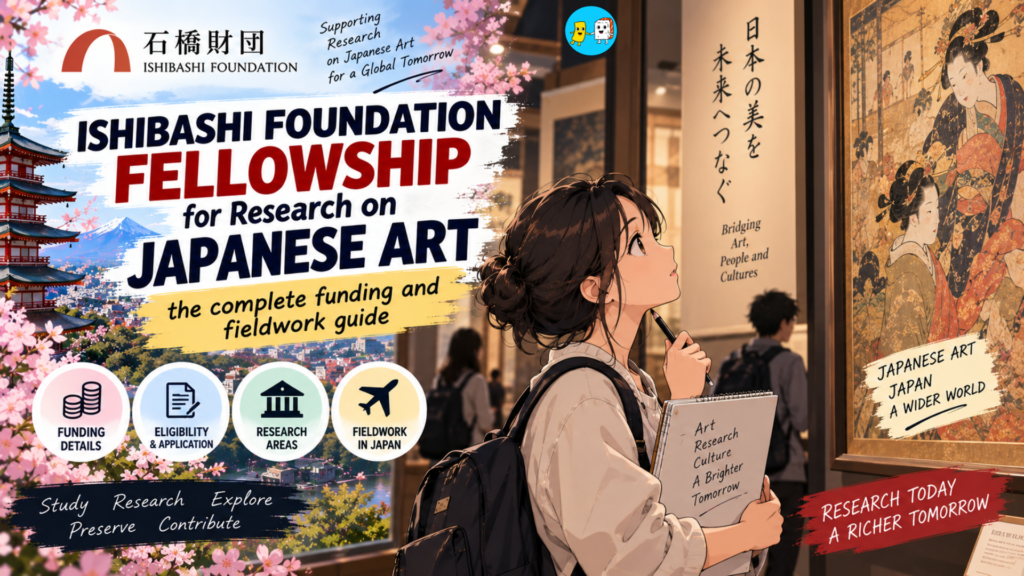
Ishibashi Foundation Fellowship for Research on Japanese Art: the complete funding and fieldwork guide
皆さん、こんにちは!(Hello everyone!)
Hey everyone, Akash, AKA Indori in Japan. If you work with Japanese art, in a museum, a university, a conservation lab, or as a writer, you already know the wall you hit: you can read every digitised catalogue online, but until you stand in front of the actual painting, handle the archival paper, or talk to Japanese curators face to face, your research stalls. And an independent research trip to Japan gets expensive fast once you add up Tokyo hotels, Shinkansen tickets, archive fees, and flights.

That’s the gap this fellowship fills. The Ishibashi Foundation / Japan Foundation Fellowship for Research on Japanese Art is a fully funded research residency that brings foreign specialists to Japan for an intensive fieldwork trip, with flights, a daily stipend, a research budget, and insurance all covered. This guide walks through how the money works, who qualifies, how to write a proposal that gets picked, and what the fieldwork actually looks like day-to-day.
Who's behind the grant?
Knowing the two organisations helps you pitch to them, because this isn’t a generic travel bursary.
The Ishibashi Foundation was founded by Shojiro Ishibashi, who also founded Bridgestone. He was a serious art collector who believed art should be shown, not locked away, so he opened the Bridgestone Museum of Art in central Tokyo, which later reopened after a major renewal as the Artizon Museum. He built one of Japan’s finest collections of French Impressionism and modern Japanese Western-style oil painting (Yoga), and his foundation has always focused on dialogue between Japanese art and the wider world.
The Japan Foundation is Japan’s main agency for international cultural exchange, under the Ministry of Foreign Affairs. This fellowship is run by the Visual Arts Section of its Arts and Culture Department.
Together, their aim is straightforward: train the next generation of international specialists in Japanese visual art, so that Japanese art gets represented well in museums and books around the world, and so money isn’t the thing that stops serious research from happening.
The structure: a short, intensive residency
Most fellowships in Japan want you to relocate for a full academic year, which is fine on paper but impossible for a working museum curator, chief conservator, or professor with responsibilities at home. You can’t walk away from your exhibitions or teaching for twelve months.
This one solves that with a 21-to-59-day window, roughly three to eight weeks. That’s long enough for real archival work, studio visits, and in-person object inspection, but short enough to take as approved study leave without derailing your job.
Because it’s intensive, the rules during your stay are strict. You have to stay in Japan continuously for the whole approved term, no side trips abroad. Book 40 days, and you’re on Japanese soil for all 40. And extensions aren’t allowed under any circumstances, so you can’t tack on an extra week on the foundation’s money at the end.
The schedule follows Japan’s fiscal year (1 April to 31 March). For a cycle closing in early December, your arrival has to fall between late June the following year and the end of that fiscal March. That gives you a comfortable eight to nine months between your award notice in April and your arrival, plenty of time to line up museum access and build your itinerary.
What you can (and can't) research
The program covers Japanese visual arts broadly, and the stated priority is contemporary Japanese art.
Don’t let that scare you off if your work is on an earlier era, because the scope is genuinely wide. Past cohorts have covered classical Buddhist sculpture, pre-modern woodblock prints, traditional crafts like Echizen washi papermaking and Yuzen textile dyeing, twentieth-century graphic design, post-war photography, architectural philosophy, and digital light installations. If it lives in the world of Japanese visual expression, material culture, or art history, it fits.
But there are two firm lines to know before you write a word.
First, it does not fund making art. If you’re a studio artist wanting money to paint, sculpt, or stage a show, you’re not eligible, this is strictly research, curatorial work, criticism, and conservation. For making work, look at artist-in-residence programs or the Japan Foundation’s separate artist exchange grants.
Second, commercial film goes elsewhere. If your project is really about mainstream cinema history or commercial filmmaking, you apply through the Japan Foundation’s Japanese Studies Fellowship instead. But moving-image art made for galleries, video installations, and experimental visual work sits squarely inside visual arts and is fully eligible.
One more thing the committee weighs heavily: your dissemination plan. They don’t want your findings sitting in a private notebook. Applicants with concrete plans to share the work publicly, a museum exhibition, a published catalogue, a university-press book, peer-reviewed essays abroad, get priority. Show them their investment will put Japanese art in front of audiences overseas.
What the fellowship pays
The financial package is strong, and it’s built to cover essentially every major cost.
The core benefit is a flat daily allowance (per diem) of ¥17,000 a day, paid directly to you for housing, meals, local transit, phone, and incidentals. Over the minimum 21 days that’s ¥357,000; over the full 59 days it reaches ¥1,003,000. Because it’s a flat allowance and not a capped reimbursement, how you spend it is up to you, book a sensible weekly furnished apartment or academic guest house and you’ll cover housing and food and still live comfortably.
Your long-distance travel is fully handled: a round-trip discount economy ticket between your home airport and Tokyo, along the most direct route, booked by the Japan Foundation. Important: don’t buy your own ticket without written permission first, because a flight you book independently without approval can’t be reimbursed.
On top of that, there’s a research allowance of up to ¥100,000 for direct project costs, intercity rail (Shinkansen between Tokyo, Kyoto, Osaka, and regional centres), museum and gallery admissions, rare Japanese-language books, image reproduction fees, and licensing for future catalogues. To claim it you need authentic Japanese tax receipts (ryoshusho) for every expense, submitted with an itemised statement at the end.
Finally, they provide overseas travel insurance for your whole residency. Japanese healthcare is excellent, but a hospital visit as an uninsured foreigner is costly, so this is real peace of mind if something goes wrong in the field.
Fieldwork and daily life in Japan
Getting approved is the milestone; planning the logistics is the actual work. The Japan Foundation doesn’t provide housing or assign dorms, you operate as an independent professional and arrange your own accommodation and schedule.
Housing choice matters. A central Tokyo business hotel for six or eight straight weeks adds up fast. Experienced researchers book monthly serviced apartments, weekly rental mansions, or academic housing like the International House of Japan (I-House) in Roppongi. Furnished weekly apartments in Ueno, Kanda, or Nippori give you a kitchenette and easy JR and subway access while staying well inside the ¥17,000 daily budget.
A heads-up on archives: Japanese art collections often work differently from Western libraries. Where many international universities have open stacks you can browse, most specialised Japanese art archives use closed stacks with strict viewing protocols.
A few institutions will likely anchor your research: the Tokyo National Research Institute for Cultural Properties (Tobunken) in Ueno, with rare files and press clippings back to the Meiji era; the National Museum of Modern Art, Tokyo (MOMAT) Art Library, strong on twentieth-century Japanese modernism; the Artizon Museum Library and Archive, for the Ishibashi collection and modern Japanese oil painting; the Tokyo National Museum (TNM) Research Center, essential for pre-modern scrolls, screens, calligraphy, and crafts; and university holdings at Tokyo University of the Arts (Geidai) and Musashino Art University.
Start your outreach early, because many archives require formal introductory letters, exact call numbers, and appointments booked weeks ahead. Walk in unannounced expecting primary documents and you’ll be turned away.
And don’t confine yourself to Tokyo. So much of Japanese visual art is regional. Post-war avant-garde like the Gutai Art Association means time in Kansai, Osaka, Kyoto, Kobe, Ashiya. Site-specific and environmental art might take you to the Echigo-Tsumari Art Triennale in Niigata, the art islands of the Seto Inland Sea across Kagawa and Okayama, or the 21st Century Museum of Contemporary Art in Kanazawa. The Shinkansen makes multi-city fieldwork easy, and since research-related domestic travel comes out of your ¥100,000 allowance, you can build an itinerary that follows your project.
Who can apply
This is aimed at active professionals and specialists living outside Japan who genuinely need to examine visual art sources in person. You don’t have to be a full professor, but you do need to be an established professional or advanced specialist. There are five categories.
Museum curators and exhibition directors at public galleries, private museums, contemporary spaces, or university collections abroad, using the grant for studio visits, loan negotiations, and catalogue essays. Academic researchers and university faculty (lecturers, assistant and associate professors, postdocs) at overseas institutions working on Japanese art history, aesthetics, or East Asian material culture. Conservators and restoration specialists preserving Japanese paper art, screens, Buddhist sculpture, lacquerware, or textiles, perhaps studying historical pigments or mounting methods. Independent art historians and critical writers with verifiable published criticism, curated shows, or monographs, even without a permanent university or museum post. And advanced doctoral candidates at ABD status only, PhD students who’ve finished all coursework and exams and have only the dissertation left, whose Japan research feeds directly into that dissertation and future publications.
Eligibility rules and who's excluded
Cross-check these before you spend weeks on a proposal.
You need nationality or formal permanent residency in a country with diplomatic relations with Japan. A Japanese citizen abroad isn’t eligible unless they hold PR elsewhere; someone whose only citizenship is from a country without diplomatic ties to Japan can’t apply even with PR in an eligible third country. Your health needs to support intensive solo fieldwork, trains, museum stairs, long independent days, so applicants certify they’re in good health. You need professional working proficiency in English or Japanese; no JLPT certificate is required if English works for your project and your host archives, but you must be genuinely fluent in your working language. And your topic has to sit firmly within Japanese visual arts, with priority on contemporary art; if it edges into general cultural studies, show clearly that visual culture is the core.
You can’t apply if you’re: a practicing artist wanting to make studio work or hold a commercial show; focused on general commercial cinema (apply to the Japanese Studies Fellowship instead); an undergraduate or master’s student, or anyone planning to enrol in a Japanese degree program; someone using the grant to study Japanese, fundraise, do political activity, or missionary work; a previous Japan Foundation fellow who hasn’t observed the three-year wait (at least three full calendar years between your last grant ending and 1 April of the target fiscal year); or someone seeking overlapping funding, you can’t hold another concurrent fellowship or apply to other Japan Foundation schemes in the same fiscal year.
How to apply, step by step
The deadline is 1 December at 1:00 PM Japan Standard Time, so start three to four months out.
Step 1: define your core question and prove you need to be there. Nail the central question, then answer why you must be physically in Japan. Committees quickly bin proposals that could be done from a home library. Write down the exact paintings, prints, textiles, letters, or private collections you need to see in person, and explain why physical inspection or local interviews are essential to your argument.
Step 2: contact Japanese institutions and specialists. Form Q-FW asks you to list the institutions, archives, and individuals you’ll work with. A signed contract isn’t required, but early outreach matters enormously. Email curators, professors, and archive heads describing your project and asking whether collections will be available on your dates. Attaching informal confirmations or letters of support proves your plan is real.
Step 3: build a realistic day-by-day itinerary. Map your dates inside the 21-to-59-day window and lay out what you’ll do each week. Be honest about travel time, two weeks in Tokyo archives, five days in Kyoto on temple collections, three days at Naoshima and Teshima, and show how it connects. A well-paced plan signals you understand Japan’s geography and can manage your time.
Step 4: line up two strong recommendations. Two letters from senior scholars, museum directors, or department heads who can speak to your work and your project. Approach them early and share your narrative, itinerary, and the selection criteria. A letter that confirms your project’s significance and that Japan fieldwork is essential beats a generic character reference.
Step 5: write your dissemination plan and research budget. Spell out the pipeline: the planned exhibition with tentative dates, venues, and reach; or the book with a prospective publisher, format, and timeline. Then itemise your up-to-¥100,000 research allowance, Shinkansen fares, museum fees, reproduction costs.
Step 6: complete Form Q-FW on the online portal. Everything is submitted through the Japan Foundation Online Application Portal. Make your account early, complete every narrative field, upload your CV, and register your two recommenders so they get automated invitation links before the cutoff. Proofread, check nothing’s missing, and submit well ahead of the 1 December, 1:00 PM JST deadline.
How your proposal is judged
Every Form Q-FW dossier goes to a committee of senior art historians, museum directors, and cultural-exchange administrators, assessed on eight things: the clarity and feasibility of the project (tight and focused beats a broad overview of Japanese art history); the indispensability of being in Japan (the single most important point, name the exact works, uncatalogued archives, or interviews that require you on the ground); the practicality of your itinerary (logical travel time, confirmed access); your professional track record (exhibitions, essays, catalogues that connect to this project); your future potential as an advocate for Japanese art; public dissemination and social impact (outcomes that reach beyond your own CV); the timing of your output (results shared within one to two years score higher); and your contribution to the field (lasting partnerships between foreign and Japanese institutions).
Key details at a glance
| Item | Details |
|---|---|
| Form | Q-FW, Visual Arts Section, Arts and Culture Department |
| Run by | The Japan Foundation, funded by the Ishibashi Foundation |
| Focus | Japanese visual arts, priority on contemporary art |
| Who applies | Curators, academics, conservators, visual arts educators, ABD PhDs |
| Excluded | Making artwork; general commercial film studies |
| Duration | 21 to 59 consecutive days |
| Stay rules | Continuous presence required; no extensions, no exits |
| Japanese requirement | None for October entry; JLPT N2+ for direct April entry |
| Arrival window | From 20 June of the next fiscal year to 31 March of its close |
| Per diem | ¥17,000/day (housing, meals, local transit) |
| Total stipend | ¥357,000 (21 days) to ¥1,003,000 (59 days) |
| Research allowance | Up to ¥100,000, against ryoshusho receipts |
| Flights | Round-trip economy, booked by the Japan Foundation |
| Insurance | Overseas travel medical and repatriation cover |
| Language | Professional working English or Japanese |
| Success rate | 18.7% (14 of 75 in FY2026) |
| Prior-grant wait | 3 full calendar years since any previous JF grant |
| Deadline | 1 December, 1:00 PM JST, via the online portal |
| Results | April the following year |
FAQs: Your Questions Answered
Q1. Can artists use this to make new work in Japan?
No. Practicing artists can’t use it to produce artwork, set up a studio, or hold a solo show. It’s strictly for research, curatorial work, conservation, and criticism. For making work, look at artist-in-residence programs or the Japan Foundation’s cultural specialist exchange grants.
Q2. What makes a dissemination plan strong?
Concrete commitments, not vague hopes. The committee prioritises confirmed exhibition dates, signed catalogue contracts with university presses, scheduled symposia, or peer-reviewed publishing agreements. “I hope to write an article someday” is weak. Put venues, projected visitor numbers, catalogue print runs, and timelines directly in Form Q-FW.
Q3. Can doctoral students apply, and how do they compete with curators?
Yes, if they have official ABD status with all coursework done before the fellowship starts. Master’s and undergraduate students aren’t eligible. For ABD applicants, the committee wants to see the research leading to a peer-reviewed publication, a curated show, or an academic book, not just satisfying a dissertation requirement. Curators bring venues; doctoral candidates with strong publication pipelines and leadership potential compete on equal terms.
Q4. Do I need a formal host agreement to apply?
No binding contract is required for Form Q-FW, but you must name the institutions, collections, and scholars you’ll visit, with their titles and affiliations. Your application is much stronger with preliminary letters of support or email confirming access on your dates.
Q5. How do reimbursements and daily expenses work?
You manage your own living arrangements. The ¥17,000 daily allowance covers rent, meals, and local transit. Direct research costs like Shinkansen trips, museum tickets, and materials come from the up-to-¥100,000 research allowance, and to claim them you need authentic Japanese tax receipts (ryoshusho) with the business name and official stamp, submitted with an itemised report at the end.
Conclusion: Where to start
This is one of the most generous and respected research fellowships in the field, and the short, intensive model makes real fieldwork in Japan possible for busy curators, scholars, and conservators.
If you’re applying for the next cycle, start early. Identify the specific artworks and archives in Japan your research depends on. Reach out to Japanese curators and archivists to build your network and confirm access. Draft a realistic day-by-day itinerary. Above all, be clear about how you’ll share the results publicly through exhibitions, catalogues, or publications. Line up your two recommenders well ahead, get familiar with Form Q-FW, and submit through the Japan Foundation Online Application Portal before the 1 December, 1:00 PM JST deadline.
Do it properly, and this can open real doors for your curatorial career, your scholarship, and the flow of Japanese art into the wider world.
✍️ Bonus: Need Help Starting?
✅ Job hunting tips and real listings for foreigners in Japan
✅ Visa guidance made simple—no confusing search
✅ Resume & cover letter templates (Japanese & English formats)
✅ Life in Japan explained — from rent to ramen
✅ Travel guides & city recommendations for every kind of explorer
✅ Work culture insights to help you adjust and thrive