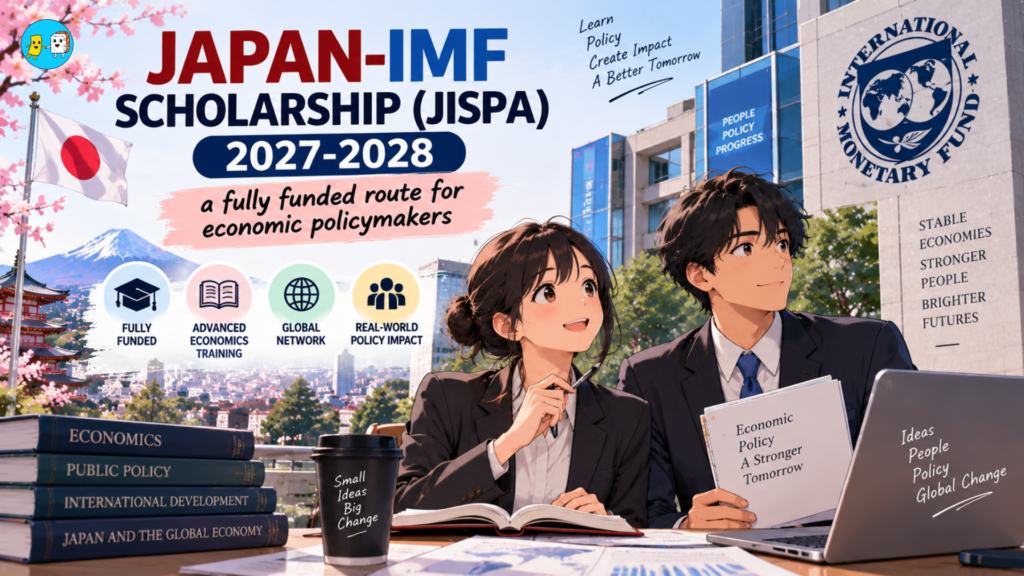
Japan-IMF JISPA Scholarship 2027-2028: a fully funded route for economic policymakers
皆さん、こんにちは!(Hello everyone!)
Hello everyone. If you want an advanced degree in economics, public policy, or financial administration without paying a rupee, rupiah, or peso out of pocket, Japan’s government scholarships are the route. Most people know the general MEXT scholarship. Fewer know about the specialised one built for people who actually run macroeconomic policy: the Japan-IMF Scholarship Program for Asia, or JISPA.
JISPA started in 1993 as a partnership between the Government of Japan (through its Ministry of Finance) and the IMF, run out of the IMF Regional Office for Asia and the Pacific in Tokyo. Over three decades, it has awarded more than a thousand scholarships to public servants across emerging Asia-Pacific economies. It isn’t a general grant open to any field. Its mandate is narrow and deliberate: train the next generation of central bankers, finance-ministry officials, tax administrators, and macroeconomic analysts who shape their countries’ fiscal and monetary policy.
Why do Japan and the IMF keep funding this? Because financial trouble doesn’t respect borders. Crises, sovereign debt stress, and inflation shocks spread across a connected region, so equipping public-sector economists across Asia with better analytical tools strengthens the whole system. And studying policy in Japan gives you a vantage point Western programs rarely match: a country that rebuilt its industrial economy, fought deflation, pioneered unconventional monetary policy, and managed a demographic crunch while holding society together. JISPA scholars aren’t studying in isolation either; they’re in English-taught graduate programs, meeting senior Japanese civil servants, and sitting in on policy dialogues with IMF economists.
For the 2027-2028 intake, the program wants junior and mid-career government officials with strong analytical ability, a real public-service record, and a clear commitment to their home country’s development. Here’s the full picture: the money, the universities, the strict eligibility, the exam, and the timeline.
What the money covers JISPA Scholarship
A master’s or PhD abroad means tuition, health cover, and living costs in an expensive city. On a civil-service salary in an emerging economy, that’s often an impossible ask. JISPA removes it entirely.
- Tuition and fees. You pay no institutional fees at all. The scholarship waives and pays directly for the entrance exam and screening fees, the one-time matriculation charge, and full annual tuition for the standard length of the degree, one to two years for a master’s, up to three for a PhD, subject to yearly progress reviews. The money moves straight between the program and the university, so you never handle an invoice.
- Monthly stipend. You get a structured monthly living allowance for rent, food, transit, books, and incidentals, generally between ¥157,000 and ¥242,000, set by your host institution and local costs. In central Tokyo, where rent is higher, it covers comfortable accommodation in international houses or private apartments; at a regional campus like the International University of Japan in Niigata, it stretches considerably further.
- Flights and arrival allowances. Travel is covered door to door: a direct economy ticket from the airport nearest your home duty station to Japan at the start, and an equivalent return ticket when you finish. There’s also a pre-arrival allowance for passport, visa, and medical-check costs, and a one-time settling-in allowance on arrival for deposits, a phone plan, and basic household setup.
- Health cover and research support. You’re enrolled in Japan’s National Health Insurance, which covers 70% of medical costs, with the co-pay handled through university-managed insurance the fellowship supports. The program also funds field trips to industrial zones, major infrastructure, the Bank of Japan, and the Tokyo Stock Exchange, and PhD Track scholars get extra grants for field research, data collection, and presenting at international conferences.
- Two hard limits. Family costs, spouse or children, aren’t covered under any circumstances; every ticket, stipend, and insurance package is calculated for the individual scholar only. And you can’t hold another scholarship, sponsorship, or grant at the same time, or take outside employment while studying.
Who qualifies for JISPA Scholarship
Because JISPA is a capacity-building tool, not a general scholarship, the criteria are strict and strictly enforced.
Eligible countries. You need citizenship of one of 22 designated emerging Asia-Pacific economies: in South Asia, Bangladesh, Bhutan, India, Maldives, Nepal, Sri Lanka; in Southeast Asia, Cambodia, Indonesia, Lao P.D.R., Malaysia, the Philippines, Thailand, Timor-Leste, Vietnam; in Central Asia, Kazakhstan, the Kyrgyz Republic, Tajikistan, Turkmenistan, Uzbekistan; and in East Asia and the Pacific, Mongolia, Papua New Guinea, and recognised Pacific Island Countries. Dual nationality that includes a non-eligible country or Japanese citizenship rules you out, and countries not on the list, Pakistan, for example, aren’t eligible.
Eligible employers. This is the distinctive part: you must be a permanent civil servant in a core agency that actually shapes macroeconomic policy. That means central banks and monetary authorities; ministries of finance, treasury, or economy; planning, development, and commerce ministries; tax, customs, and revenue bodies; national statistics bureaus; and financial regulators or banking-supervision commissions. Officials in other technical departments only qualify if their agency directly influences national fiscal strategy. Private firms, state-owned non-financial corporations, commercial banks, NGOs, and development consultancies don’t qualify at all.
Age and experience. JISPA targets young, high-potential officials, generally under 36 at the time of applying. Priority goes to applicants under 40 with two to three years of continuous full-time service in their sponsoring agency.
Education. For the Master’s Track, an accredited bachelor’s degree representing at least 16 years of formal schooling. If your system produces a three-year degree (15 years), you can still be considered with an official explanation from your national education authority, approved by the committee. For the PhD Track, an accredited master’s in economics, public policy, or a related quantitative field (at least 17 years of education), with a strong transcript and a research record.
Agency nomination (mandatory). Independent applications are rejected automatically. You need an official Agency Nomination and Certification Form, signed and stamped by a senior official in your ministry or central bank, that does three things: nominates you, approves study leave (up to two years for a master’s, three for a PhD), and guarantees you’ll be reinstated into a policy role afterward. And if you’ve been on extended leave or off active duty for more than one consecutive month in the 12 months before 1 September 2027, you can’t apply.
English. Everything is taught in English, so you need professional working proficiency: TOEFL iBT 79-80 or IELTS Academic 6.0 overall, sent using the JISPA institution code (C626 for TOEFL). If you did your degree entirely in English in a recognised English-medium country, India, the Philippines, and some Pacific nations included, you may qualify for an exemption. No Japanese is required.
Who's excluded
A few things disqualify you outright: already holding a master’s or doctorate from a university outside your home country (for the Master’s Track, since the program prioritises officials who haven’t yet studied abroad); being active-duty military or civilian defence staff; working in the private or commercial sector; being unable to get or keep a Student (Ryugaku) visa; or being unwilling to return home and serve your agency after graduating.
The universities and tracks
JISPA has two streams: a Master’s Track through four partner universities, and a PhD Track open across Japan.
GRIPS (Tokyo). The National Graduate Institute for Policy Studies, in Roppongi, is Japan’s top graduate school for public governance and economic policy. Under its Macroeconomic Policy Program it runs a one-year master’s for mid-career officials with strong maths backgrounds (30 credits, leading to a Master of Public Policy or Public Economics) and a two-year master’s for deeper theory and research (36 credits, a Master of Arts in Public Economics with a full thesis). Faculty include prominent economists and former senior officials from the Ministry of Finance and the Bank of Japan.
Hitotsubashi University (Tokyo area). One of Japan’s most prestigious social-science universities. JISPA scholars join the School of International and Public Policy for the Asian Public Policy Program, a Master of Public Policy in Public Economics. Cohorts are small (around 15 students, roughly four per supervising professor), and the focus is public-sector economics, public finance, tax administration, and sovereign debt, ideal for finance-ministry and tax-authority officials.
International University of Japan (Niigata). IUJ in Minamiuonuma runs an all-English, fully residential campus. Through its Graduate School of International Relations it offers a two-year Macroeconomic Policy Program leading to a Master of Arts in Economics, with training in central banking, monetary transmission, forecasting, financial-sector development, and trade policy. Because the whole community lives on campus, it’s also the hub for the compulsory Orientation Program.
University of Tokyo (GraSPP). UTokyo’s Graduate School of Public Policy offers a two-year Master of Public Policy, International Program, and JISPA scholars go into the Economic Policy, Finance and Development stream. It’s quantitatively rigorous, blending advanced theory with political economy, international law, and data-driven evaluation, aimed at executive-level roles managing balance-of-payments crises and financial stability.
The PhD Track. For officials who already hold a master’s and can do serious research, the PhD Track funds doctoral study, and unlike the master’s stream it isn’t limited to the four partners. You can seek admission to any accredited university in Japan, including Kyoto, Osaka, Kobe, or Waseda. You have to secure institutional acceptance independently, and once admitted JISPA covers up to three years of tuition, stipend, and research grants.
The Orientation Program in Niigata
Before their autumn term, every new Master’s Track scholar does a mandatory eleven-week Orientation Program at IUJ in Niigata, running early July to late September. The point is to bring a diverse cohort of civil servants, some years out from their undergrad, up to the same starting line.
It covers four areas: advanced mathematics and quantitative economics (calculus, constrained optimisation with Lagrange multipliers, matrix algebra, probability, and intro econometrics), academic writing and policy research (empirical papers, econometric citation, briefing notes), introductory Japanese for daily life, and cross-cultural acclimation. That last part matters more than it sounds: the residential setting bonds the incoming class of roughly 35 public-sector economists into a professional network across the region that lasts for the rest of their careers.
How to apply, step by step
The selection process is genuinely rigorous, testing your paperwork, your maths, and your analytical judgement. Five stages.
Step 1: internal approval, documents, research idea. Start months before the portal opens. Get your supervisors, director, and HR to sign the Agency Nomination and Certification Form. At the same time, gather certified transcripts, degree certificates, and your TOEFL or IELTS scores. The centrepiece is your research proposal and Statement of Purpose (400-600 words), and here’s the key: skip the purely theoretical topic. Focus on an empirical problem your country actually faces, inflation targeting, public-debt consolidation, exchange-rate volatility, tax compliance, and explain how training in Japan helps you tackle it.
Step 2: the online application. The Master’s Track portal opens 15 September 2026 and closes 20 October 2026. Upload your details, academic history, agency information, SOP, research plan, certified transcripts, and nomination form as a single consolidated PDF. Two confidential references (one academic, one supervisory) go through the portal or directly to the IMF admissions address by 1 November 2026.
Step 3: the maths exam. Clear the document review and you’re invited to a proctored Mathematics Examination on 3 December 2026. It’s an objective quantitative test across national systems, covering differential and multivariate calculus (partial derivatives, total differentials, optimisation), linear algebra (matrix operations, determinants, inversion, systems of equations), and probability and statistics (distributions, expectation, variance, hypothesis testing). Prepare with undergraduate economics maths textbooks and practise multi-variable optimisation and matrix work under time pressure.
Step 4: interviews. Strong exam scores get you shortlisted for interviews between late January and late February 2027, run by joint panels of university professors and senior IMF economists. They assess your grasp of core macro and micro theory, the clarity and policy relevance of your research, your awareness of your country’s macroeconomic vulnerabilities, and your commitment to returning to public service.
Step 5: results, acceptance, visa. Results are announced 11 March 2027, with acceptance due 18 March 2027 and reserve offers from 19 March. From March to June you complete onboarding: the university files for your Certificate of Eligibility, you get your Student Visa, do a final medical, and book flights. The cohort arrives 7-8 July 2027 and starts the Orientation Program at IUJ on 9 July, before university classes begin in late September or October. The PhD Track runs on a separate calendar: the portal opens 1 May 2027 and closes 1 June 2027 for autumn 2027 or spring 2028 entry.
The key numbers
| Item | Details |
|---|---|
| Funded/run by | Government of Japan (Ministry of Finance)/IMF Regional Office, Tokyo |
| Since | 1993; 1,000+ recipients; ~35 selected a year |
| Eligible countries | 22 designated Asia-Pacific economies |
| Eligible employers | Central banks, finance/economy ministries, planning, tax, statistics, regulators |
| Master's universities | GRIPS, Hitotsubashi, IUJ, University of Tokyo (GraSPP) |
| PhD Track | Any accredited university in Japan (admission secured independently) |
| Tuition & fees | 100% waived, paid directly |
| Monthly stipend | ~¥157,000 to ¥242,000 |
| Travel | Round-trip economy airfare, plus pre-arrival and settling-in allowances |
| Age | Generally under 36 (priority under 40); 2-3 years' service |
| Education | Bachelor's/16 yrs (master's); Master's/17 yrs (PhD) |
| English | TOEFL iBT 79-80 or IELTS 6.0 (code C626); exemptions for English-medium countries |
| Nomination | Mandatory agency form; guarantees leave and reinstatement |
| Orientation | 11 weeks at IUJ, Niigata (9 July to 22 September 2027) |
| Master's deadline | Portal 15 Sep 2026, closes 20 Oct 2026; references by 1 Nov 2026 |
| Maths exam | 3 December 2026 |
| Interviews | Late January to late February 2027 |
| Results | 11 March 2027 (accept by 18 March) |
| Arrival | 7-8 July 2027 |
| PhD deadline | Portal 1 May 2027, closes 1 June 2027 |
| Obligation | Mandatory return to your sponsoring agency |
FAQs: Your Questions Answered
Q1. Can I apply if I work in a private commercial bank or corporate finance?
No. JISPA is for building public-sector policymaking capacity, so eligibility is limited to permanent officials in central banks, finance and economy ministries, planning bodies, tax administrations, statistics bureaus, and financial regulators. Every application needs an Agency Nomination and Certification Form confirming study leave and guaranteed reinstatement. Staff of private banks, investment funds, corporate firms, NGOs, and consultancies are ineligible.
Q2. What's on the December maths exam, and how do I prepare?
Three areas: calculus (partial derivatives, chain rule, total differentials, unconstrained and Lagrange-constrained optimisation), linear algebra (matrix operations, determinants, inversion, systems of equations, basic vector spaces), and probability and statistics (distributions, expectation, variance, hypothesis testing, basic regression). Work through undergraduate texts like Chiang’s Fundamental Methods of Mathematical Economics or Simon and Blume’s Mathematics for Economists, and practise multi-variable optimisation and matrix operations against the clock.
Q3. Can I bring my spouse and children?
The scholarship covers no family costs, only the individual scholar’s airfare, stipend, settling-in allowance, and insurance. Since your first eleven weeks are intensive residential study at IUJ in Niigata, the advice is to travel alone at first. After orientation, once you’ve settled into your university accommodation, you can sponsor dependents on a Japanese Dependent Visa if you can show enough personal funds to cover their flights, housing, and living costs.
Q4. How does the Master's Track differ from the PhD Track?
The Master’s Track is centralised: you apply through the IMF portal in September-October, sit the maths exam in December, interview in January-February, and do the Niigata orientation, all tied to the four partner universities. The PhD Track is open, you can apply to any accredited Japanese university, must secure admission independently, apply for JISPA funding between 1 May and 1 June 2027, and skip the summer orientation, going straight into doctoral research.
Q5. Can I work in Japan or join an international organisation afterward?
No. JISPA has a mandatory return requirement, since it’s public money aimed at building capacity across Asia. You can’t switch to a work visa for Japan’s private sector; you return to your sponsoring agency. Graduating doesn’t guarantee an IMF job, but alumni go home with strong credentials and often represent their countries in talks with the IMF, World Bank, and regional development banks. Those who complete at least four years of public service afterward also become eligible for the JISPA Continuing Education Program, a two-week policy refresher in Japan.
Conclusion: Where to start
A fully funded JISPA place is a genuinely big opportunity for a young public-sector economist: all costs covered, plus access to top faculty, IMF economists, Bank of Japan policymakers, and a thousand-strong alumni network running economic policy across the region.
Getting into that cohort of roughly 35 takes early, deliberate preparation. Start by talking to your directors to secure the mandatory Agency Nomination and Certification Form. Review your calculus, linear algebra, and statistics for the maths exam on 3 December 2026. And draft a tight, empirical research proposal built around a real macroeconomic or fiscal challenge your country is facing. Work each stage carefully and you can turn your public-service experience into a serious academic step in Japan, and take that training straight back into shaping your country’s economic policy.
✍️ Bonus: Need Help Starting?
✅ Job hunting tips and real listings for foreigners in Japan
✅ Visa guidance made simple—no confusing search
✅ Resume & cover letter templates (Japanese & English formats)
✅ Life in Japan explained — from rent to ramen
✅ Travel guides & city recommendations for every kind of explorer
✅ Work culture insights to help you adjust and thrive