Kyoto University Hakubi Project: how it works, what it pays, and how to apply
皆さん、こんにちは!(Hello everyone!)
Welcome back. If you’re a degree-seeking student heading to Japan, government routes like the MEXT scholarship are usually the answer. But if you’re already past your PhD and looking for a real faculty position, one with intellectual freedom, a decent salary, research money, and no crushing teaching load, that’s a different search. This post is about one of the best options for that: the Hakubi Project at Kyoto University.

The Hakubi Centre for Advanced Research opened in September 2009 on a simple idea: good research needs free time and an unconstrained mind, not committees and lecture prep. Fifteen-plus years in, it has supported more than 250 researchers from around the world.
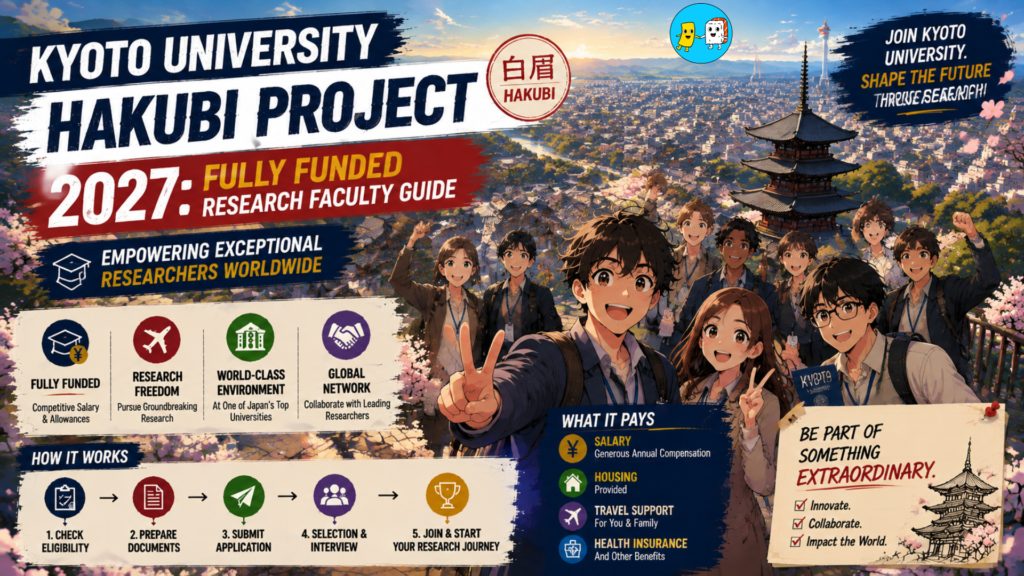
The Global Category track offers five-year fixed-term faculty appointments as a program-specific associate or assistant professor. You get an annual research grant, a full home inside a Kyoto University department, and a community of fellows from wildly different fields. Below is everything worth knowing: eligible fields, the actual salary and grant numbers, the selection stats, the timeline, some strategy, and the questions people always ask.
Who and what qualifies
The disciplinary net is unusually wide. Where a lot of fellowships fund a narrow slice of STEM, Hakubi takes proposals from across the map.
Recent cohorts make the range obvious. In humanities and social sciences, accepted projects have covered early modern English imperial religious policy, Iranian diaspora literature, Hindu art iconography, and participatory post-disaster recovery. On the physical sciences side: holographic duality in quantum gravity, continuum mechanics in supercompensation theory, and rare-event searches using multimodal AI. In life sciences and medicine: vocal intelligence in Asian elephants, mitochondrial dynamics in cancer therapy, adaptive mechanisms in animal development, and somatic cell evolution in chronic disease.
To apply under the Global Category, you need to clear a few bars. You must hold a PhD, or be able to show research ability that’s equivalent or better if you don’t have one on paper. Any nationality, any age; there are no caps or citizenship rules. If you’ve been a Hakubi researcher before, you can’t reapply. And you can’t run a Global Category application alongside another tenure-track call at Kyoto University at the same time.
You need a host inside Kyoto University
Fellows sit officially under the Hakubi Centre, but the actual work happens in a host department, a graduate school, research institute, or centre somewhere in the university.
So every applicant has to find and contact a prospective host professor before or during the application. That professor guides you, helps with the paperwork, and sorts out lab space or a desk. They have to be employed by Kyoto University, and their informal consent is required by the time you reach the second-stage interview at the latest. Leave this too late, and it becomes the thing that sinks an otherwise strong application.
Money, benefits, and the length of the deal
Hakubi researchers are employed directly by Kyoto University as program-specific faculty, so you’re fully inside the Japanese academic system, not attached to it from the outside.
Rank and salary
Your title tracks your experience and publication record: program-specific associate professor, program-specific junior associate professor, or program-specific assistant professor.
Pay follows an annual salary system under Kyoto University’s rules for fixed-term program-specific faculty, on the standard university payroll scales. One thing to note: the usual allowances (housing, commuting, dependents, and year-end bonuses) are baked into that annual figure rather than paid as separate monthly top-ups. There’s no retirement severance at the end of the term.
The research grant
On top of salary, every fellow gets a direct annual research grant between ¥1,000,000 and ¥4,000,000. The exact amount depends on your project and how well you justify your experimental costs in the proposal. It covers equipment, reagents, computing, fieldwork, archive travel, and open-access publication fees. You’re also free to chase external money, including JSPS KAKENHI grants, on top of this.
Insurance
Everyone gets full-time employee benefits through the MEXT Mutual Aid Association: health insurance and medical care, Employees’ Pension Insurance (Kōsei Nenkin), Employment Insurance (Koyō Hoken), and Workers’ Accident Compensation Insurance.
Five years, and how leave affects it
Appointments are fixed at five years. The 16th batch, for instance, runs 1 April 2026 to 31 March 2031. You can push the start date back for visa or personal reasons, but the end date stays pinned to 31 March of the fifth year no matter what.
The term is non-renewable under normal conditions. The exception: maternity, childcare, or family caregiving leave can extend the overall appointment by the length of the leave, worked out in consultation with the institution.
The timeline, step by step
The whole cycle runs roughly nine months from registration to offer.
Step 1: watch the portal, grab the templates (mid-March to April). The recruitment portal opens every year between mid-March and early April. Register an account, download the Word and PDF proposal templates, and read the Applicant Registration and Proposal Preparation Instructions, the FAQ, and the KAKENHI Review Section Table so you can slot your project under the right disciplinary code.
Step 2: draft the proposal and start emailing hosts (April). Write your proposal on the standard Hakubi template, and at the same time start reaching out to potential host professors across relevant graduate schools and institutes. Your first email should carry an academic CV, a publication list, a research abstract, and a note on the lab space or equipment you’d need.
Step 3: upload and submit (mid-May deadline). Proposals go up before the deadline, usually mid-May, for example 17 May at 23:59 JST. The system does not send a confirmation email when you submit, so log back in and check that your file shows as complete. Formal confirmation of acceptance comes about a week after the deadline.
Step 4: first-stage document review (June to September). The Expert Committee reads every dossier, organised into field-specific sub-committees, and judges on academic record, originality, feasibility, and leadership potential. Interview shortlists go out by late September.
Step 5: second-stage interview (late November or early December). Shortlisted candidates defend their work in front of the Hakuraku Council, a mix of senior scholars and institutional leaders, internal and external. You can present in English or Japanese. They’re testing your vision, how clearly you communicate across disciplines, and whether you look like a future academic leader. Your host professor’s informal consent has to be locked in before this.
Step 6: final decision and offer (late December). The Steering Committee, made up of vice presidents, deans, and centre directors, makes the call. Successful candidates get an informal offer (naiitei) in late December, and formal appointment starts on 1 April.
What makes Hakubi different: freedom and cross-pollination
The real draw here isn’t just the money. It’s that fellows are completely free of mandatory teaching and administrative committees, so you get five uninterrupted years to actually think.
To stop people from disappearing into their own silos, the Centre runs an ongoing program it calls the “Exchange of Different Martial Arts” (Ishū Kakutōgi). Structural biologists end up trading methods with diaspora literature specialists, and that’s the point.
The rhythm looks like this. Hakubi Seminars run twice a month, on the first and third Tuesdays at 16:30, organised on rotation by the fellows themselves, where you present ongoing work to people from entirely different fields. Annual research camps are two-day, one-night off-campus retreats in mid-December for intensive interdisciplinary workshops. Hakubi Day and the annual report meetings happen every March as public symposia where current fellows and alumni (“Post-Hakubi”) share progress and keep their networks warm. Farewell ceremonies in September give graduating researchers a final stage to sum up five years before they move on to tenured or international posts.
And there are no interim performance reviews. That’s a design choice, not an oversight: it lets you take on high-risk, multi-year questions without scrambling to publish something small every year.
Strategy from Akash for winning a spot
Getting in means pairing technical rigour with broad appeal. A few things that help.
Match the KAKENHI codes, but keep the vision legible. Use the official KAKENHI Review Section Table so first-stage screeners in your exact field recognise the technical validity of what you’re doing. The catch is that the second-stage Council is made up of generalists from across humanities and STEM, so your core text has to stay readable for them too. Say plainly why the project matters, what assumption it challenges, and why it moves the field.
Line up your host early. Don’t leave this to the last week. Reach out two to three months before the deadline with a tight research outline and a clear reason why their lab or department is the right home for you. Professors say yes far more readily when you’ve shown how your work fits what they’re already doing.
Understand the gender equality rules. Kyoto University aims for women to make up at least half of new hires. If a female and a male applicant score equally, the rules give priority to the female candidate. And anyone, women and men both, who paused their research for childbirth, childcare, or eldercare can ask the committee to weigh those breaks when reading their publication record.
Rehearse the interview for non-specialists. The Council is judging you as a potential leader, not just a technician. Practise explaining your research without dense jargon. Talk about collaboration, international networks, public science communication, and cross-disciplinary work, and show you actually want to take part in the seminars and the wider community.
The key numbers at a glance
| Item | Details |
|---|---|
| Host institution | Kyoto University, Hakubi Centre for Advanced Research |
| Location | Kyoto, Japan |
| Track | Global Category (program-specific faculty) |
| Titles | Associate, junior associate, or assistant professor |
| Positions per year | About 20 |
| Recent acceptance rate | ~4.45% (16th batch) |
| Tenure | 5 years, fixed, non-renewable |
| Annual research grant | ¥1M to ¥4M |
| Salary | Annual salary system, allowances included |
| Insurance | Full MEXT Mutual Aid coverage |
| Eligibility | PhD or equivalent research ability; any nationality, any age |
| Host requirement | A Kyoto University professor's informal consent, by the interview stage |
| Portal opens | Mid-March to early April |
| Submission deadline | Mid-May (e.g. 17 May, 23:59 JST) |
| Interviews | Late November or early December |
| Offer | Late December, start 1 April |
FAQs: Your Questions Answered
Q1. Do I need host consent before I upload my application?
Not on upload day. Formal consent isn’t required the moment you submit. But you should contact potential hosts as early as you can, because informal consent becomes mandatory by the time the Council interviews happen.
Q2. Can non-Japanese scholars do everything in English?
Yes. Forms, proposal documents, and the second-stage presentation can all be in English. A bit of conversational Japanese helps for daily life in Kyoto, but language is not a barrier in the evaluation itself.
Q3. Can I apply without a PhD?
Yes, if you can show research ability that’s equivalent or better. The Expert Committee assesses that during document screening, based on your publications, research history, and contributions.
Q4. How is the grant paid, and can I also apply for KAKENHI?
The ¥1M to ¥4M annual grant is set from the budget justification in your proposal and the Steering Committee’s review. Experimental fields with high consumable costs usually get more than theoretical ones. Funds run through your host department’s finance office under standard Kyoto accounting. And yes, you can still apply for external funding like JSPS KAKENHI.
Q5. Can I push my start date past 1 April?
Yes, to wrap up a contract abroad or sort out a visa. However late you start, the appointment still ends on 31 March of the fifth year. The five-year clock doesn’t reset.
Conclusion: Where to start
The Hakubi Project is a rare thing: five years of faculty-level security, up to ¥4M a year in research money, and zero mandatory teaching, all pointed at letting you do the work you actually care about. If that fits where you are in your career, here’s how to begin.
Read accepted project summaries on the Hakubi Centre website first, so you can calibrate the depth and scope they expect. Then dig through Kyoto University’s graduate school and institute faculty directories to find hosts whose interests overlap with yours. Draft a proposal that states your hypotheses, methods, expected outputs, and a realistic budget in the ¥1M to ¥4M range. Reach out to those hosts early with a polished CV, publication list, and research synopsis to get informal consent well before the interview stage. And keep an eye on the portal between March and April so you don’t miss registration or the mid-May deadline.
✍️ Bonus: Need Help Starting?
✅ Job hunting tips and real listings for foreigners in Japan
✅ Visa guidance made simple—no confusing search
✅ Resume & cover letter templates (Japanese & English formats)
✅ Life in Japan explained — from rent to ramen
✅ Travel guides & city recommendations for every kind of explorer
✅ Work culture insights to help you adjust and thrive