
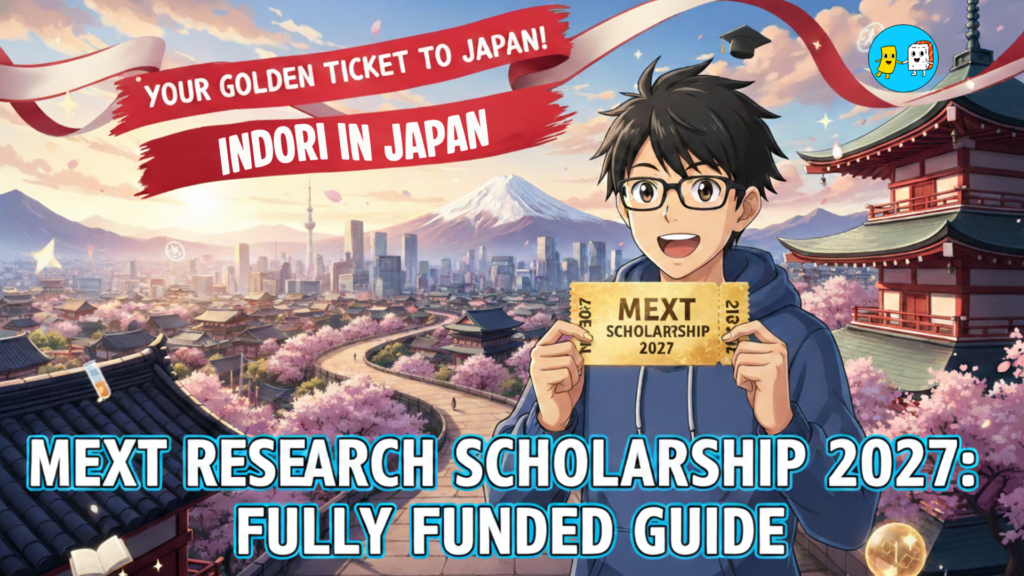
MEXT Research Scholarship 2027: Fully Funded Guide
皆さん、こんにちは!(Hello everyone!)
Scholars and aspiring students, if you have been dreaming of studying in Japan without spending a single rupee from your pocket, then listen closely! This isn’t just any scholarship; this is the MEXT Research Scholarship 2027—a premier opportunity that covers everything from your flight tickets to your tuition and provides a monthly stipend to ensure a comfortable life in major cities like Tokyo or Osaka.

The application process can be demanding. The forms are meticulous, the regulations are strict, and even minor errors can lead to immediate disqualification. As someone who has transitioned from a standard academic background in India to achieving high honours and a successful career in Japan, I have developed this 2500-word roadmap to bridge the gap between your ambition and the Japanese administrative requirements. Let’s explore the details!
What is the MEXT Research Scholarship?
The MEXT (Monbukagakusho) Scholarship is a prestigious, fully funded program sponsored by the Japanese Government. For the 2027 cycle, it specifically targets Indian scholars who wish to pursue a Master’s degree, a PhD, or a professional graduate degree.
This is truly a “golden ticket” for your career. Whether your research focus is Robotics, Artificial Intelligence, Business Administration, or Japanese Literature, MEXT provides the necessary resources. Beyond academic excellence, Japan is looking for researchers who can act as an intellectual bridge between the two nations, possessing both technical skills and a commitment to cultural integration.
The 2027 MEXT Research Scholarship Snapshot (Key Statistics and Data)
Below is the competitive reality for the 2027 cycle in India. Success requires beating these benchmarks through rigorous preparation.
| Program Metric | Details for the 2027 MEXT Research Scholarship |
|---|---|
| Age Limit | Born on or after April 2, 1992 (Under 35 years) |
| Academic Requirement | 70% in Bachelor's/Master's (65% for Humanities) |
| Monthly Stipend | ¥143,000 to ¥145,000 (Approx. ₹83,000 - ₹85,000) |
| Document Success | ~7.5% of Indian applicants clear preliminary screening |
| Interview Success | ~33% chance of recommendation after the written exam |
| Application Fee | ₹0 (Completely free via the Embassy track) |
| Annual Indian Slots | ~80 to 120 students across all categories |
| Language Expectation | No initial mandate, but "willingness to learn" is required |

Eligibility and the "1 MB Technical Rule"
Before drafting your research plan, you must confirm your eligibility. The Japanese administration follows bureaucratic guidelines with extreme precision.
Primary Criteria
- Nationality: Applicants must be Indian citizens. If you hold dual Japanese citizenship, you must relinquish it before arriving in Japan in 2027.
- Educational Background: You must have completed 16 years of formal education. For Master’s programs, you need 70% in your Bachelor’s degree (Science/Engineering) or 65% (Humanities). Doctoral applicants require 70% in their Master’s degree.
- Health Status: You must be physically and mentally fit to conduct research abroad. A health certificate signed by a professional physician is required later in the process.
- GPA Standard: While MEXT requires a minimum of 2.3 on a 3.0 scale, most successful candidates aim for a near-perfect 3.0 to remain competitive.
The Strict 1 MB Submission Rule
The Embassy of Japan in India enforces a specific submission protocol. Your preliminary application must be in Microsoft Word format (.doc or .docx) only, and the file size must not exceed 1 MB. Submissions in PDF, scanned handwriting, or Google Drive links will be automatically rejected. This is a primary test of your ability to follow professional instructions.
Comprehensive Financial Benefits (MEXT Research Scholarship)
The MEXT scholarship is designed to remove all financial stress so you can focus entirely on your academic objectives.
- Full Tuition Coverage: 100% of the entrance examination, admission, and tuition fees are waived.
- Tiered Monthly Stipend:
- Non-degree Research Students: ¥143,000 per month.
- Master’s/Professional Degree Students: ¥144,000 per month.
- Doctoral Degree Students: ¥145,000 per month.
- International Logistics: The scholarship provides round-trip airfare from the nearest international airport in India to Japan.
- Preparatory Education: If your Japanese proficiency is insufficient, MEXT funds a 6-month intensive language course at institutions like Osaka University or Tokyo University of Foreign Studies.
Drafting a High-Impact Research Plan
The Field of Study and Research Program Plan is the most critical document in your application. It is viewed as an “aspirational document” that demonstrates your potential as an independent researcher.
Key Strategic Steps:
- Define the Research Gap: Clearly state the problem you intend to solve. Avoid generic topics; instead, focus on a specific niche that requires advanced resources.
- Establish the Japanese Connection: You must articulate why your research must be conducted in Japan. This could involve access to specific technological labs, historical archives, or unique Japanese social data.
- Bridge Past and Future: Show how your undergraduate thesis or work experience naturally transitions into this new research theme.
- Detail the Methodology: Explain exactly how you will collect and analyse your data—whether through laboratory experiments, field surveys, or document reviews.
- Adhere to Constraints: The proposal is strictly limited to two pages. Writing concisely while maintaining depth is a skill that reviewers value highly.
Expert Advice: Utilise Google Scholar to identify current publications by Japanese professors. Aligning your proposal with their current research trends demonstrates professional diligence.
Navigating the Written Exams
For the 2027 Research track, the written examinations are scheduled for June 28, 2026.
- Exam Subjects: All research applicants must sit for both English and Japanese language tests.
- Weightage: For STEM students, the English score is paramount, whereas for Humanities students, both scores are heavily scrutinised.
- The Japanese Exam Challenge: Even if you do not know the language, you must attempt the test. Achieving a basic level (N5 or N4) shows a commitment to integration and significantly improves your overall ranking during the embassy selection.
The Selection Timeline and Interview Logic
The journey to an April 2027 arrival begins a full year earlier. Following the timeline is essential.
- Mid-April 2026: Official guidelines released by the Embassy.
- May 15, 2026: Deadline for Preliminary Application Form.
- June 28, 2026: Written Examination in New Delhi.
- Early July 2026: Online Interview for shortlisted candidates.
- Until September 1, 2026: Candidates must secure a “Letter of Provisional Acceptance” from Japanese universities.
- January – February 2027: Final notification from MEXT Japan.
Interview Tactics:
You will have approximately 10 to 12 minutes to present your case. Expect questions regarding your motivation for choosing Japan over the West, your plans for contributing to bilateral relations, and how you will handle research challenges. A humble and polite demeanour, characteristic of Japanese professional culture, is highly recommended.
Adaptation and Life in Japan
Living in Japan involves more than just academic work; it is a major cultural transition.
- Educational Shift: Japanese universities prioritize application-based learning over rote memorization. You will spend significant time in your “Zemi” or research seminar groups.
- Social Challenges: Loneliness and homesickness are common among international students. Statistics suggest that 90% of female and 75% of male Indian students abroad miss their family support systems acutely. Building a network of trustworthy friends is essential.
- Dietary Adjustments: For vegetarians, navigating Japanese menus requires caution. Many dishes contain “Dashi” (fish stock). Learning to communicate dietary needs in Japanese is a critical survival skill.
- Part-Time Work: Scholars can work up to 28 hours per week with a permit, but the stipend is generally sufficient to cover all living expenses without external work.
The Career Trajectory Post-Scholarship
A MEXT degree is a global signal of resilience and high specialisation.
- Job Market Boom: With Japanese companies investing ¥5 trillion in India, scholars with Japanese proficiency have a massive competitive edge.
- The N2 Mandate: For top-tier professional roles in Japan, a JLPT N2 level is now the standard requirement.
- Salary Potential: Successful scholars often secure roles with starting salaries exceeding ₹22 Lakh per year in sectors like Engineering, IT, and Finance.
Frequently Asked Questions (FAQs)
Q1. Is the Japanese language exam mandatory if I research in English?
Yes, you must take it to show your cultural interest. While Science students are not disqualified for low scores, showing basic proficiency like N5 or N4 significantly strengthens your application.
Q2. Can I apply if I am in my final semester of a Bachelor’s?
Yes. You can apply as a “prospective graduate.” You simply need to provide your final degree and mark sheet by September 30, 2027.
Q3. What happens if I fail the initial application due to the 1 MB rule?
Your application will be automatically rejected. The Embassy does not provide a second chance for technical errors. Always ensure your Word file is optimised for size.
Q4. How do I find a research advisor in Japan?
After passing the first screening at the Embassy, you will receive a certificate of passing. You then use this to contact professors directly or via university administrative offices to request a Letter of Provisional Acceptance.
Q5. Are there restrictions on the fields of study?
You cannot pursue practical training in traditional arts or clinical medical training without a Japanese license. Your research must be academic and related to your previous major.
Conclusion: Take the First Step Toward Your Future
The MEXT 2027 Research Scholarship is a transformative platform that offers more than just funding; it offers a long-term career impact. By meticulously following the administrative rules—specifically the 1 MB Word file requirement—and drafting a specialised research plan, you can successfully navigate this competitive selection.
The next application window opens around April-May 2026. Use this time to refine your research goals, study the Japanese language, and prepare for the academic journey of a lifetime. Japan is an excellent destination for researchers, and for the dedicated scholar, Japan is the place to be!.
Stay focused and pursue excellence in every step!
✍️ Bonus: Need Help Starting?
✅ Job hunting tips and real listings for foreigners in Japan
✅ Visa guidance made simple—no confusing search
✅ Resume & cover letter templates (Japanese & English formats)
✅ Life in Japan explained — from rent to ramen
✅ Travel guides & city recommendations for every kind of explorer
✅ Work culture insights to help you adjust and thrive


1 thought on “MEXT Research Scholarship 2027: Your Fully Funded Golden Ticket to Japan!”
Loved the article on “MEXT 2027”. Thank you soo much bhaiya! 🫶🏻🥹