
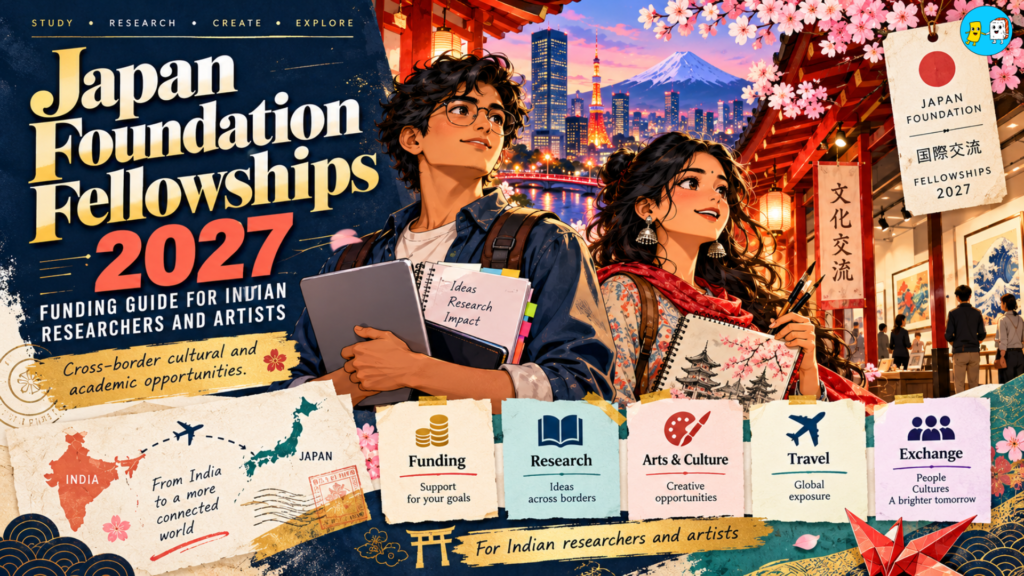
Japan Foundation Fellowships 2027: funding guide for Indian researchers and artists
皆さん、こんにちは!(Hello everyone!)
Funding is the wall most researchers hit. High living costs, expensive travel, and the logistics of a long residency abroad stop even committed specialists in Asian studies, contemporary art, and cross-cultural work from doing fieldwork in Japan. The Japan Foundation Fellowship program removes that wall with full funding. For Indian researchers, doctoral candidates, curators, and artists, the 2027 cycle opens a real chance to do intensive fieldwork, work with primary archives, and build professional networks in Japan.

This guide covers the three fellowship tracks, the money, who qualifies, the India-specific tax angle, the application route, and the deadline. The aim is to help you submit a competitive proposal that matches what the foundation wants.
Who runs the fellowships?
The Japan Foundation sits under Japan’s Ministry of Foreign Affairs. Its mission is global understanding, Japanese-language education, and cultural and intellectual exchange between Japan and the world. The programs split into branches for different disciplines, so pick the one that fits your work.
For humanities and social science academics, the Japanese Studies Fellowship Program is the main funding route. It supports foreign scholars doing dedicated research in Japan, and it strengthens the global field of Japanese studies by bringing international scholars into local academic networks.
For creative professionals and cultural coordinators, the Japan Foundation Fellowship for Arts and Culture in Asia runs under the WA Project 2.0. It focuses on reciprocal opportunities between Japan and ASEAN countries, and Indian nationals often qualify through specific Indo-Pacific and global partnership frameworks, depending on their affiliation and the call released by the Japan Foundation New Delhi office.
The Ishibashi Foundation Fellowship for Research on Japanese Art is a specialised branch run with the Japan Foundation’s Visual Arts Section. The Ishibashi Foundation was founded by Shojiro Ishibashi of Bridgestone, who built the Bridgestone Museum of Art, now the Artizon Museum. It supports curators, educators, and conservators in visual arts, with priority on contemporary Japanese art.
The structure: how long you stay
The length depends entirely on the track you pick, so choose the one that matches your method.
The Japanese Studies Fellowship offers three timelines. The Short-Term Research Fellowship runs 21 to 89 days, for established scholars who need a focused window to gather materials, run local interviews, or finish a publication. The Long-Term Research Fellowship runs 4 to 12 months, for wider comparative work, data collection, or manuscript writing. The Doctoral Fellowship also runs 4 to 12 months, for doctoral candidates at All But Dissertation status who need fieldwork to finish the thesis.
The Arts and Culture Fellowship has a short-term track of 10 to 59 days and a long-term track of 60 to 180 days. The Ishibashi Art Fellowship runs a strict 21 to 59 days, reflecting its focus on targeted archival research.
One rule applies across all of them: a continuous physical stay. You must not split the tenure into segments or go home midway. The timing also follows the Japanese fiscal year, so for 2027 your arrival falls between 20 June 2027 (or 1 July 2027 for Arts and Culture) and 31 March 2028. Plan your timeline inside those windows, with no unauthorised side trips or conferences in third countries.
What qualifies and what does not
The foundation sets firm thematic boundaries, and knowing them is the first step to a strong proposal.
The Japanese Studies Fellowship covers the humanities and social sciences: history, literature, sociology, political science, economics, and comparative studies that substantially involve Japan. Your research must need physical travel to Japan. If the primary materials sit online or in Indian institutions, the proposal gets rejected. You have to show that being in Japan is essential to your method.
The Arts and Culture branch covers visual arts, performing arts, music, literature, film, lifestyle culture, and sports, through research, creative development, collaborative projects, and community network-building.
The Ishibashi Fellowship covers Japanese visual arts only. Traditional crafts, classical sculpture, and modern photography all qualify, but the committee prioritises contemporary Japanese art.
The exclusions are strict. No funding for natural sciences, engineering, or medicine. No support for undergraduates, master’s candidates, or anyone enrolling in a degree course at a Japanese university. In visual arts, studio art production (making the artwork) is barred, as is general commercial filmmaking. Religious advocacy and political projects are ineligible too.
What the fellowship pays
The financial support removes the cost of fieldwork, and the exact figure depends on your track.
Short-Term Research Fellows, including Ishibashi Art Fellows, get a flat daily per diem of JPY 17,000. Over a 59-day stay that reaches JPY 1,003,000, covering accommodation, meals, and local transit.
Long-Term Research Fellows in the Japanese Studies program get a monthly stipend of JPY 400,000, and Doctoral Candidates get JPY 310,000 a month. Long-term fellows also get a one-time settling-in allowance of JPY 250,000 on arrival for deposits, utilities, and household basics, and a departure allowance of JPY 50,000 at the end. A long-term fellow accompanied by dependents for at least three continuous months gets an extra JPY 10,000 per person per month plus dependent insurance. Institutional enrolment fees of up to JPY 25,000 a month are covered if the host university requires them.
Across all categories, the foundation arranges and pays round-trip discount economy airfare by the most direct route from your home country, and provides overseas travel insurance automatically. Art researchers also get a research allowance of up to JPY 100,000, on a reimbursement basis with official Japanese tax receipts (ryoshusho).
The tax angle for Indian fellows
Indian researchers should think about tax on grant money. The India-Japan Double Taxation Avoidance Agreement (DTAA) gives you a protective framework. Under the usual provisions of such treaties, money sent from abroad strictly for maintenance, education, study, or research is generally exempt from tax in the host state. International tax law is complex, so talk to a tax advisor in New Delhi or your local jurisdiction to structure your finances and stay compliant in both countries.
Fieldwork and daily life in Japan
A research residency needs real logistical planning, and you operate with professional independence throughout.
Housing is your responsibility. The foundation does not book it for you. Past fellows use serviced apartments like Oakwood or weekly mansions in the major cities, which have kitchens and flexible leases suited to 21-to-180-day stays without a two-year Japanese lease. For an embedded academic community, the International House of Japan in Roppongi is excellent and competitive, with strong library access.
Primary materials live in specialised, tightly regulated archives: the Tokyo National Research Institute for Cultural Properties (Tobunken), the National Museum of Modern Art Tokyo Art Library, the Artizon Museum Library, and the Tokyo National Museum Research and Information Center. You often need a formal letter of introduction from your Japanese host to enter rare-book reading rooms and special collections.
To handle all of this, work through a clear sequence well before you arrive.
Define the exact artworks, texts, and archives your method needs. A vague wish to study Japanese culture gets rejected, so name the specific manuscripts, historical catalogues, or practitioners you have to consult.
Contact Japanese institutions and specialists well ahead of the December deadline. Securing a host or advising specialist is the most time-consuming part of the whole process. The host provides written confirmation of support, which takes extended email correspondence and relationship-building.
Build a realistic day-by-day itinerary. The committee checks physical feasibility. A plan covering Hokkaido, Tokyo, Kyoto, and Okinawa in 21 days gets dismissed as impossible. Account for national holidays, library closure days, and transit times between prefectures.
Secure two strong recommendations from professors or senior curators who vouch for your record and for why the Japan fieldwork is essential.
Draft a dissemination plan. The foundation prioritises work that reaches the public, through academic books, international exhibitions, or open-access digital databases usable by researchers in India.
Submit online before the deadline. All documents go through the Japan Foundation Headquarters Online Application Portal by 1 December 2026 at 1:00 PM Japan Standard Time.
Once accepted, move on the visa. The Embassy of Japan in New Delhi and its VFS Global centers across India usually process cultural and long-term research visas in four to seven working days from submission. Allow a realistic two to five weeks end to end, to absorb appointment delays, document checks, and passport dispatch. The foundation does not expedite visas, so apply early.
How your proposal is judged
Selection is rigorous and competitive. In the FY2026 cycle, 67 of 176 applications won the Japanese Studies Fellowship, 14 of 61 won Arts and Culture in Asia, and 14 of 75 won Research on Japanese Art.
A committee of field experts weighs several criteria. The first is the clarity of your research purpose and whether the goal is achievable within your term. The committee scrutinises the geographical necessity of being in Japan. If digitised archives from New Delhi or Mumbai would do the job, you will not get funded. The panel also weighs your track record and your capacity to deliver, and it prefers candidates with a concrete plan to publish or present results soon after the fellowship. Projects should also fit the foundation’s wider mission of building human networks and developing the next generation of people leading cross-border work between Japan and the Indo-Pacific.
The key numbers
| Aspect | Japanese Studies | Arts and Culture | Research on Japanese Art |
|---|---|---|---|
| Who | PhD candidates, academics | Artists, curators, producers | Art professionals, conservators |
| Focus | Humanities, social sciences | Performing arts, music, film | Visual arts (priority: contemporary) |
| Duration | 21-89 days or 4-12 months | 10-59 days or 60-180 days | 21-59 days |
| Stipend | JPY 310,000-400,000/mo or JPY 17,000/day | Varies | JPY 17,000/day |
| Arrival window | 20 Jun 2027 to 31 Mar 2028 | 1 Jul 2027 to 31 Mar 2028 | 20 Jun 2027 to 31 Mar 2028 |
| Key ineligibility | STEM, medical, undergraduates | Studio art production | Filmmaking, non-visual arts |
| Deadline | 1 Dec 2026, 1:00 PM JST | 1 Dec 2026, 1:00 PM JST | 1 Dec 2026, 1:00 PM JST |
FAQs: Your Questions Answered
Q1. Are Indian citizens eligible, and do I need to be in India when I apply?
Yes, Indian citizens qualify because India has diplomatic relations with Japan. You generally reside outside Japan and hold nationality or permanent residency in an eligible country. Residency rules vary by subcategory, but Indian scholars based in India or other eligible locations are encouraged to apply.
Q2. What level of Japanese do I need?
You need proficiency in Japanese or English. If your research runs entirely in English, you must prove the host and the archives support English-based work. If the project involves classical Japanese texts or interviews in rural areas, the committee checks whether your Japanese is strong enough to finish the stated research.
Q3. Is travel outside Japan allowed during the grant for a conference?
No. Continuous presence in Japan for the whole term is a strict, non-negotiable condition. You must not split the itinerary, go home, or visit a third country for any reason during the grant period.
Q4. Does the fellowship cover family members?
Only for specific long-term tracks. Short-term fellows get no dependent allowance. Long-Term Scholars and Doctoral Candidates accompanied by dependents for at least three continuous months get an extra JPY 10,000 per person per month plus dependent insurance. The foundation never covers airfare for dependents.
Q5. What if I have no Japanese host by the 1 December deadline?
An application without a confirmed host reads as incomplete or uncompetitive. The foundation requires you to arrange your local advisor or research associate in Japan before the deadline, since the committee needs proof you will have the institutional access and support to finish the fieldwork.
Conclusion: Where to start
The most damaging mistake is treating 1 December as far off. Formal contact with a Japanese host takes time, patience, and professional diplomacy. Advisors and curators in Japan run demanding schedules, and a stamped letter of acceptance often takes two to three months of steady correspondence.
Start refining your research abstract today. Turn a broad interest into a sharp, achievable, location-dependent question, that is the foundation of a strong application. Cross-reference your target materials with the real locations of those archives in Japan, so your itinerary is logical and cost-effective. Read the official guidelines in full, because small portal errors lead to disqualification with no appeal.
The Japan Foundation Fellowships for 2027 open a strong path for Indian scholars and artists. By covering airfare, living costs, and research expenses, they remove the financial barrier between you and the primary resources held in Japan, so you engage with Japanese culture, history, and contemporary art without the pressure of instability.
That generosity comes with a demanding selection process. Winning takes more than a strong idea. It takes clean logistics, early and respectful contact with a Japanese host, and a clear plan to share your results with the wider world. If you approach it with precision, respect for the deadlines, and a sharp sense of purpose, you put yourself in a strong position. Finalise every abstract, reference letter, and portal upload well before 1 December 2026, and you give yourself a real shot at the bridge between India and Japan.
✍️ Bonus: Need Help Starting?
✅ Job hunting tips and real listings for foreigners in Japan
✅ Visa guidance made simple—no confusing search
✅ Resume & cover letter templates (Japanese & English formats)
✅ Life in Japan explained — from rent to ramen
✅ Travel guides & city recommendations for every kind of explorer
✅ Work culture insights to help you adjust and thrive