Ritsumeikan University Scholarships: The Ultimate Fully Funded Guide for Indian Students
皆さん、こんにちは!(Hello everyone!)
The educational landscape of Western Japan has emerged as an exceptionally prestigious, secure, and career-defining destination for international scholars. At the absolute forefront of this academic renaissance stands Ritsumeikan University, a premier private institution boasting over 125 years of historical excellence. Across its world-class campuses in Kyoto, Shiga, and Osaka, Ritsumeikan University hosts over 39,000 students, including Western Japan’s third-largest international student population. For ambitious Indian students seeking a global competitive edge in engineering, technology, international relations, and public policy, this university offers an unmatched launchpad.

However, pursuing higher education abroad represents a significant financial undertaking. Through the expert analysis of Akash, the lead educational consultant at Indori in Japan, this report provides a comprehensive, strategic guide to navigating Ritsumeikan University’s highly competitive, fully funded and partially funded scholarship systems. By aligning academic goals with institutional priorities, Indian students can successfully secure generous financial packages that cover tuition, accommodation, travel, and daily living costs, enabling a smooth transition into Japan’s high-paying technology and corporate sectors.
Highlights of the Scholarship Programme
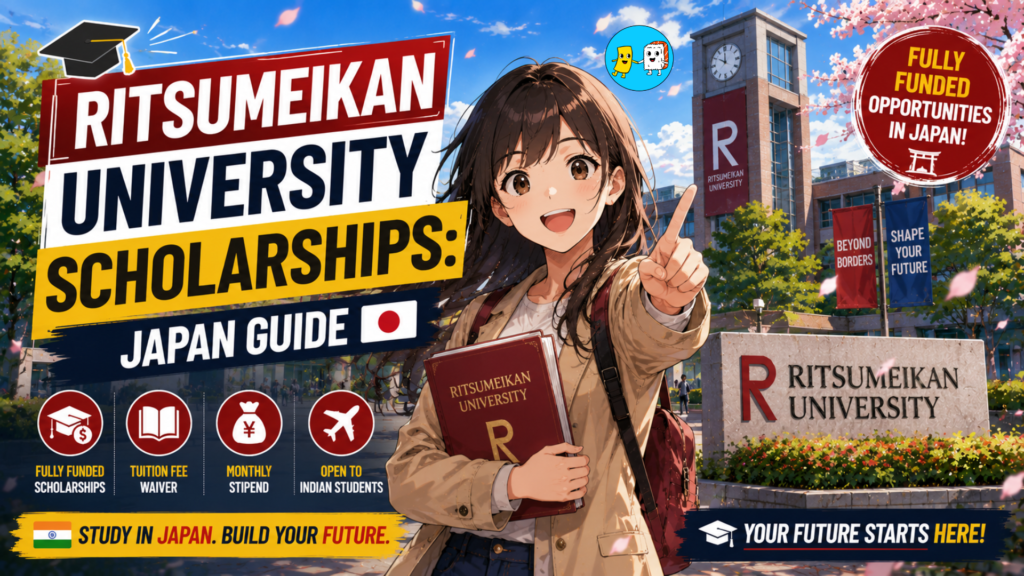
The financial packages available through Ritsumeikan University and its sponsoring partners are designed to eliminate the economic barriers that often prevent talented international scholars from accessing world-class research facilities. The primary benefits of these funding schemes are structured as follows:
- Complete Tuition Fee Waivers: Selected scholars receive full coverage of admission fees and standard annual tuition, reducing the academic cost of attendance to zero.
- Robust Monthly Subsistence Allowances: To offset the cost of living in Japan’s major urban centres, scholars are provided with a monthly living stipend ranging from 120,000 JPY for undergraduates up to 148,000 JPY for advanced postgraduate researchers.
- Fully Covered Round-Trip Air Travel: Sponsoring bodies pay for economy-class flights from the student’s home airport in India to Japan at the start of the programme, as well as the return flight upon graduation.
- Debt-Free Academic Progression: Because these awards are structured strictly as non-repayable grants, recipients are liberated from financial liabilities, allowing them to focus entirely on academic publications and laboratory innovation.
- Integrated Career Pathways: Scholarship recipients gain immediate access to institutional networking events, Japanese corporate internship matching, and points-based visa advantages that accelerate the transition to Permanent Residency in Japan.
Who Can Apply for This Scholarship?
Before evaluating grades or compiling language test scores, it is crucial to establish who is eligible to apply for these elite programs. The scholarship pathways are open to:
- International Degree-Seeking Candidates: Any self-funded international student seeking full-time admission to an undergraduate or graduate degree program at Ritsumeikan University.
- High School Seniors and University Graduates: Students who are currently in their final year of high school (for undergraduate programs) or university (for Master’s/PhD programs) and are on track to graduate before the designated academic term starts in Japan.
- Applicants from Diplomatic Partner Nations: Citizens of any country that maintains formal diplomatic relations with the Japanese government are actively welcomed.
- English-Medium Program Aspirants: Students applying to enroll in Ritsumeikan’s flagship English-based courses, including the College of Global Liberal Arts (GLA), the Community and Regional Policy Studies (CRPS) major, the Global Studies (GS) major, or the Information Systems Science and Engineering (ISSE) course.
- New Resident Visa Seekers: Individuals who are prepared to acquire a new “Student” visa status and travel to Japan on the specific arrival dates determined by the university.
Key Qualification Criteria
- Eligible Nationalities: Applicants must hold citizenship of a nation that maintains formal diplomatic relations with the Japanese government, a requirement that fully encompasses Indian nationals.
- Chronological Age Boundaries: For undergraduate-level entry, candidates must generally be born on or after April 2, 2001. For postgraduate research pathways, including Master’s and PhD tracks, candidates must have been born on or after April 2, 1991.
- Academic Performance Standards: Candidates must demonstrate an excellent academic record, maintaining a minimum Cumulative Grade Point Average (CGPA) of 2.30 or higher out of 3.00, as calculated via the official grading formula of the Japanese Ministry of Education, Culture, Sports, Science and Technology (MEXT).
- Linguistic Proficiency Benchmarks: For programmes conducted in the English medium, candidates must submit proof of language proficiency equivalent to or exceeding the Common European Framework of Reference for Languages (CEFR) B2 level. This is satisfied by achieving a minimum score of 120 on the Duolingo English Test, 610 on the SAT Evidence-Based Reading and Writing section, or 25 on the ACT English section.
- Visa and Immigration Readiness: Recipients must be prepared to obtain a new “Student” resident visa before they arrive in Japan, ensuring they enter the country on the specific dates designated by Ritsumeikan University.
The Architecture of Ritsumeikan University Scholarships
Ritsumeikan University’s financial aid framework is divided into three primary categories: government-backed awards, university-funded tuition reduction initiatives, and private foundation grants. Understanding the distinct mechanisms of these programmes is critical for constructing a highly targeted application strategy.
The MEXT University Recommendation Scholarship
This prestigious award represents the gold standard of academic funding in Japan. Instead of applying through the Japanese Embassy in India, candidates apply directly to Ritsumeikan University, which screens the applicants and nominates the top candidates to the central government for funding.
For undergraduate applicants, the Special Selection track allocates specific quotas to English-medium majors, including the College of Global Liberal Arts (GLA), the Community and Regional Policy Studies (CRPS) major, and the Global Studies (GS) major. For postgraduate scholars, the Graduate Track funds Master’s and Doctoral research across diverse scientific and humanities faculties, prioritizing candidates whose research directly aligns with Japan’s technological and social development priorities.
The Ritsumeikan University Tuition Reduction Scheme
Designed as a robust safety net for privately financed international students, this institutional scheme provides tuition discounts ranging from 20% to 100%.
- Category I (100% Reduction): Automatically awarded to the top 10% of admitted undergraduate and graduate applicants based on their entrance examination performance.
- Category II (50% or 20% Reduction): Awarded to the next 10% of undergraduate enrollees (50% reduction) and standard graduate enrollees (20% reduction) to alleviate the annual tuition burden.
- Category III (20% Reduction): Awarded to all other admitted international students who hold a valid student visa, ensuring that almost every self-funded student receives financial relief.
Future applicants must note that this specific Tuition Reduction Scheme will officially conclude at the end of the 2026 academic year. The university administration is currently designing a restructured financial aid framework to take effect from the 2027 academic year onward. Consequently, students aiming for 2027 enrollment must monitor university portals closely for updated institutional funding structures.
Private and Public Foundation Scholarships
Upon formal enrollment at Ritsumeikan University, students gain access to a highly coordinated network of external scholarships. The university’s International Centre actively reviews enrolled students and provides university recommendations for prestigious private awards.
Key opportunities include the Ando Momofuku Scholarship, which provides an annual grant of 1,000,000 JPY to outstanding leaders under the age of 30, and the Japan Student Services Organisation (JASSO) Honours Scholarship, which offers a reliable monthly stipend of 48,000 JPY. For engineering and humanities majors from developing economies, regional awards such as the Asian Development Bank-Japan Scholarship Programme (ADB-JSP) cover complete tuition, travel, and healthcare, alongside a monthly living allowance.
Required Documentation Checklist
Applicants must assemble a comprehensive, professionally compiled dossier to survive the rigorous initial document screening phase. Every document must be typed in English on standardised A4-sized formatting; any supporting material issued in another language must be accompanied by an official English translation. The mandatory checklist consists of:
- Official Ritsumeikan Online Application Form: Completed and submitted via the designated university portal.
- MEXT Scholarship Application Form: The specific annual template issued by the Japanese government, filled out with absolute typographical precision.
- Detailed Field of Study and Study Program: A comprehensive research proposal mapping the applicant’s intended scientific or social investigation in Japan.
- Official Academic Transcripts: Cumulative transcripts from all previously attended secondary schools or universities, displaying clear grading scales.
- Certificates of Graduation: Official graduation certificates or duplicates of diplomas, demonstrating current or scheduled program completion.
- One-Page Thesis Abstract: A highly concise summary of the applicant’s most recently written academic thesis, graduation project, or major research paper.
- Official Language Proficiency Scores: Original score reports from IELTS, TOEFL, or Duolingo, taken within the two-year window preceding the application deadline.
- Academic Reference Letters: Letters of recommendation drafted by a university dean, department head, or primary academic advisor, directly uploaded to the application system by the referee.
- Completed Certificate of Health: A standardised MEXT medical form signed and stamped by a licensed medical practitioner within the specified application window.
Step-by-Step Application Guide
Securing a fully funded seat at Ritsumeikan University requires strict adherence to a highly structured, multi-layered administrative timeline. The recommended roadmap is detailed as follows:
Step 1: Early Academic Alignment and Portal Registration
- Prospective students must thoroughly review the available English-medium majors and identify specific faculty members whose research laboratories match their academic interests.
- Candidates must access “The Admissions Office” (TAO) online application portal and register a secure applicant account, ensuring the display language is set to English.
Step 2: Initiating Graduate Pre-Counselling
- For graduate-level applicants (Master’s and PhD), initiating contact with potential supervising professors is a crucial step.
- Applicants must submit a formal pre-counselling request via the Ritsumeikan Graduate Admissions portal prior to lodging their formal scholarship application, allowing the faculty to evaluate lab capacity and research alignment.
Step 3: Document Upload and Reference Requests
- Upload all compiled academic credentials, passports, essays, and language score reports directly to the TAO system.
- Enter the official institutional email addresses of the designated academic referees within the TAO portal. This triggers a secure system request, allowing referees to submit their recommendation letters directly to the university database.
Step 4: Application Fee Processing
- Submit the non-refundable application fee of 5,000 JPY per program via the portal’s integrated payment gateway.
- Note: Graduate-level applicants who are applying directly under the MEXT University Recommendation scholarship track are exempted from paying this application fee.
Step 5: Final Verification and Submission
- Carefully review all uploaded PDFs for typographical errors, formatting mismatches, or incomplete fields.
- Click the “Complete my application” button to transition the application status to “Application Completed” before the strict institutional deadline.
One Master Statistics Table
To ensure a highly efficient, single-point reference for prospective Indian applicants, the table below consolidates the essential parameters, financial statistics, and administrative deadlines for all major scholarship pathways at Ritsumeikan University.
| Scholarship Scheme | Target Audience & Eligible Programs | Financial Coverage & Value | Standard Award Duration | Minimum GPA & Language Requirements | Application & Deadline Windows | Official Portal & Apply Links |
|---|---|---|---|---|---|---|
| MEXT University Recommendation (Undergraduate) | Undergraduates in GLA, CRPS, and GS Majors | 120,000 JPY monthly stipend, 100% admission and tuition waiver, round-trip airfare | 4 Years (Full Degree) | Born on/after April 2, 2001; GPA ≥ 2.30/3.00; CEFR B2 (Duolingo ≥ 120) | October to March annually (multiple screening rounds) | Ritsumeikan Undergrad TAO Portal |
| MEXT University Recommendation (Graduate Track) | Master's and PhD Research Scholars | 144,000 to 148,000 JPY monthly stipend, 100% tuition/admission waiver, round-trip airfare | Standard degree duration (2 years Master's, 3 years PhD) | Born on/after April 2, 1991; GPA ≥ 2.30/3.00 on MEXT scale; CEFR B2 | Late November to late December annually (for September entry) | Ritsumeikan MEXT Graduate Portal |
| RU Tuition Reduction (Category I) | Privately financed undergraduate and graduate students | 100% Tuition waiver | 1 Year (renewable based on yearly academic performance) | Awarded to the top 10% or less of admitted applicants; must hold a Student Visa | Handled automatically during the admission evaluation | Ritsumeikan Financial Aid Hub |
| RU Tuition Reduction (Category II & III) | Privately financed undergraduate and graduate students | 20% to 50% Tuition reduction | 1 Year (renewable based on yearly academic performance) | Evaluated based on financial need and academic progression | Evaluated during admission; currently ending in the 2026 academic year | Ritsumeikan Financial Aid Hub |
| JASSO Honours Scholarship | Enrolled privately financed international students | 48,000 JPY monthly living allowance | 6 to 12 Months (eligible for competitive renewal) | Minimum GPA of 2.30/3.00 on the JASSO scale; Student Visa | Apply post-enrollment in April or October each semester | Ritsumeikan Financial Aid Hub |
| Ando Momofuku Scholarship | Enrolled undergraduate and graduate students | 1,000,000 JPY annual grant | 1 Academic Year | Under 30 years of age; exceptional leadership and university contribution | Internal university call for applications opens every Spring semester | Ritsumeikan Financial Aid Hub |
| RU Faculty & Staff Assistance Scholarship | Enrolled privately financed international students | 250,000 JPY annual grant | 1 Academic Year | Financial distress combined with solid academic progress | Post-enrollment application window opens every Spring semester | Ritsumeikan Financial Aid Hub |
| Doctoral Course Research Scholarship (A & B) | Enrolled PhD candidates | Scholarship A: Full tuition waiver; Scholarship B: Half tuition waiver | 2 Semesters (1 Academic Year) | Demonstrated excellence in research achievements; evaluated via Ri-SEARCH | Apply in May or October through the graduate school career office | Ritsumeikan Graduate Research Hub |
Frequently Asked Questions (FAQs)
Q1: Can a candidate apply for both the MEXT University Recommendation Scholarship and other private foundation scholarships simultaneously?
No, the regulations governing major fully funded scholarships, such as the MEXT program, strictly prohibit dual-funding. If an applicant is successfully nominated for a MEXT award, they cannot accept any other scholarships, including those from private foundations or the university’s internal tuition reduction programs.
However, privately financed students who do not receive the MEXT award are highly encouraged to apply for multiple post-enrollment private scholarships. In these cases, combining smaller grants is permitted, provided the total monthly stipend from other sources does not exceed the limit of 80,000 JPY.
Q2: How does the MEXT GPA recalculation affect Indian applicants who graduated from universities using a standard percentage or 10-point scale?
The MEXT scholarship utilises a strict 3.00-point scale calculation that differs significantly from standard Indian grading systems. During the administrative review, Ritsumeikan University’s admissions office converts the applicant’s official transcripts into the MEXT format.
To ensure a competitive edge, graduate applicants should aim for a minimum of 70% in their Bachelor’s degree (for Science and Engineering tracks) or 65% (for Humanities tracks). If the applicant’s official CGPA falls slightly below the converted 2.30 out of 3.00 threshold, the application will be automatically disqualified during the document screening phase.
Q3: Are English language proficiency test score waivers available for Indian students applying to English-medium degree programmes?
Yes, under specific academic circumstances, a formal waiver can be requested. If an Indian applicant has completed their entire previous degree program (e.g., a Bachelor’s degree for postgraduate applicants or high school for undergraduate applicants) at an institution where English is the sole medium of instruction, they may submit an official certificate of English medium of instruction issued by their registrar.
However, if the university’s screening committee deems this certificate insufficient, the applicant must sit for an internationally recognised exam (such as IELTS, TOEFL, or Duolingo) and meet the standard CEFR B2 score requirements.
Q4: Does the Ritsumeikan University MEXT scholarship program cover the living expenses of a spouse or children travelling with the student?
No, the MEXT scholarship is strictly structured to support the individual student’s academic and living costs in Japan. Sponsoring bodies do not provide family allowances, dependent airfare, or supplementary housing subsidies.
While international students are permitted to sponsor dependent visas for their immediate family members, they must demonstrate sufficient independent financial resources to support their dependents during their residency in Japan. Sponsoring dependents solely on the standard monthly stipend of 144,000 JPY is highly discouraged due to the high cost of family housing and health insurance in Japan.
Q5: What are the academic consequences if a scholarship recipient fails to maintain their grades after enrolling at Ritsumeikan University?
Scholarship recipients are subjected to rigorous annual academic performance reviews. For MEXT scholars, failing to maintain a cumulative GPA of 2.30 or higher out of 3.00 at the end of each academic year results in the immediate revocation of the monthly stipend.
Similarly, students holding Ritsumeikan’s internal Tuition Reduction awards must demonstrate consistent academic progress; if a student repeats an academic year, records poor attendance, or is deemed unable to graduate on schedule, the university will cancel their tuition reduction benefits.
Conclusion
The scholarship programmes offered at Ritsumeikan University represent a highly valuable, risk-free pathway for Indian students to access world-class education without the burden of severe financial debt. By providing robust financial support, complete tuition waivers, and direct connections to Western Japan’s flourishing technology and policy sectors, these programmes allow scholars to focus entirely on academic and research excellence.
Furthermore, graduating from a prestigious Japanese university like Ritsumeikan provides significant long-term career advantages. Under Japan’s Highly Skilled Professional (HSP) points-based immigration system, holding a Master’s degree yields 20 points, while a Doctoral degree yields 30 points. When combined with the high starting salaries offered to engineering and policy graduates in Japan, international alumni can realistically fast-track their pathway to Permanent Residency in as little as one to three years.
By carefully aligning their academic proposals, respecting the strict administrative deadlines, and utilising the resources provided in this guide, Indian applicants can confidently take the first step toward a transformative academic journey in Japan.
✍️ Bonus: Need Help Starting?
✅ Job hunting tips and real listings for foreigners in Japan
✅ Visa guidance made simple—no confusing search
✅ Resume & cover letter templates (Japanese & English formats)
✅ Life in Japan explained — from rent to ramen
✅ Travel guides & city recommendations for every kind of explorer
✅ Work culture insights to help you adjust and thrive