
Careers in Japan 2026: JLPT Levels & Salary Guide for Indians
皆さん、こんにちは!(Hello everyone!)
The Japanese economic landscape in 2026 presents a singular moment of opportunity for Indian professionals, characterised by a massive structural labour deficit and an unprecedented institutional openness to foreign talent. As the national unemployment rate hovers at a historical low of 2.97%, the Japanese government has projected a need for approximately 1,000,000 new immigrants within this calendar year alone to sustain industrial output and social infrastructure. For a professional from Indore or any part of India, the journey to Japan is no longer a distant dream but a strategic career move that requires a nuanced understanding of the Japanese Language Proficiency Test (JLPT) and its direct correlation to visa eligibility and earning potential. This report serves as the definitive roadmap, blending the strategic expertise of the “Indori in Japan” framework with the hard data of the 2026 job market, ensuring that every aspirant knows exactly how to navigate from a “Zero to Hero” status in the Land of the Rising Sun.

The Macroeconomic Context: Why 2026 is the Year for Japan
Japan’s current economic trajectory is defined by a paradoxical combination of a soaring Nikkei 225 index—which recently hit 51,908.00—and a critical shortage of working-age individuals. With over 18 million job openings across sectors like IT, semiconductors, robotics, and healthcare, the demand for skilled labor has surpassed domestic supply in nearly every prefecture, with Tokyo, Yokohama, and Osaka leading the vacancy counts. The “Indori in Japan” philosophy, pioneered by Akash Gautam, emphasizes that this gap represents a “golden ticket” for Indian youth who are willing to combine their technical degrees with linguistic proficiency. Akash’s own journey—from an average student in Indore struggling with mathematics and navigating a 3.02 GPA at JNU to becoming a top content creator and marketer in Tokyo—serves as a testament to the fact that with the right “jugaad” (hack) and a disciplined study routine, the transition is entirely achievable.
The 2026 job market is particularly favourable for Indian IT professionals, as the Ministry of Economy, Trade and Industry (METI) has forecasted that the generative AI market will grow by an average of 47% annually through 2030. This growth has triggered a surge in demand for backend engineers, AI researchers, and data scientists, roles where Indian talent is already globally recognized. However, the differentiator in 2026 remains the JLPT certification, which acts as the primary filter for high-paying corporate roles.
Master Job Matching & Financial Matrix (Careers in Japan 2026)
The following master table consolidates all macroeconomic indicators, career pathways by JLPT level, specialised IT roles, Specified Skilled Worker (SSW) categories, and living expenses into a single reference guide for Indian professionals.
| Category / Proficiency | Realistic Roles & Indicators | Monthly Salary (JPY) | Monthly Salary (INR Approx) | Visa & Key Notes |
|---|---|---|---|---|
| Market Indicators | Nat'l Unemployment & 18M Vacancies | ¥515,000 (Avg) | ₹2.8L (Avg) | 1M Immigrants in 2026 |
| JLPT N5 / N4 | Warehouse, Housekeeping, Konbini | ¥180,000 – ¥280,000 | ₹1L – ₹1.5L | SSW Type 1 (No family) |
| JLPT N3 | Office Admin, Support, Real Estate | ¥230,000 – ¥320,000 | ₹1.3L – ₹1.8L | Humanities / Instructor |
| JLPT N2 (Pro) | IT, Bridge SE, Marketing, Sales | ¥280,000 – ¥450,000 | ₹1.5L – ₹2.5L | Engineer / Humanities |
| JLPT N1 (Elite) | Executive, Medical, Legal, Manager | ¥400,000 – ¥800,000+ | ₹2.2L – ₹4.4L+ | Highly Skilled Pro (HSP) |
| SSW Industries | Nursing, Agri, Aviation, Transport | ¥170,000 – ¥280,000 | ₹95k – ₹1.5L | SSW 1 or 2 (Family rights) |
| IT Tech Speciality | AI, Backend, Cloud, DevOps, SRE | ¥625,000 – ¥1,250,000 | ₹3.5L – ₹7L | Engineer / Specialist |
| Cost of Living | Rent, Food, Utilities, Transport | ¥120,000 – ¥180,000 | ₹70k – ₹1.06L | Est. for Tokyo/Osaka |

Foundations of the JLPT: Mapping Proficiency to Career Paths
The JLPT is the internationally recognized benchmark for measuring Japanese language ability. It is divided into five levels, with N5 being the most basic and N1 representing native-level fluency. In the “Indori in Japan” career framework, these levels are not just academic milestones but “paisa-vasool” (value-for-money) keys to specific salary brackets and visa categories.
Entry-Level to Intermediate (N5 – N3)
At the N5 and N4 levels, the focus is on basic grammar and survival vocabulary. While insufficient for white-collar office work, these levels are the primary requirement for the Specified Skilled Worker (SSW) visa program. JLPT N3 serves as the “bridge” level, marking the transition to functional workplace communication where one can handle routine conversations and follow instructions without constant supervision.
The Professional Benchmark (N2 – N1)
In the Japanese job market, JLPT N2 is the “salary inflexion point.” This is the level that most Japanese companies consider the minimum qualification for professional, long-term employment. For an Indian “bhiya” looking to earn “ek number” (top-tier) money, N2 is the target, as it opens access to traditional Japanese giants like Toyota and SoftBank. JLPT N1 is the pinnacle of certification, sought after for executive leadership, high-stakes translation, and professions that require strict regulatory compliance, such as legal or medical services.
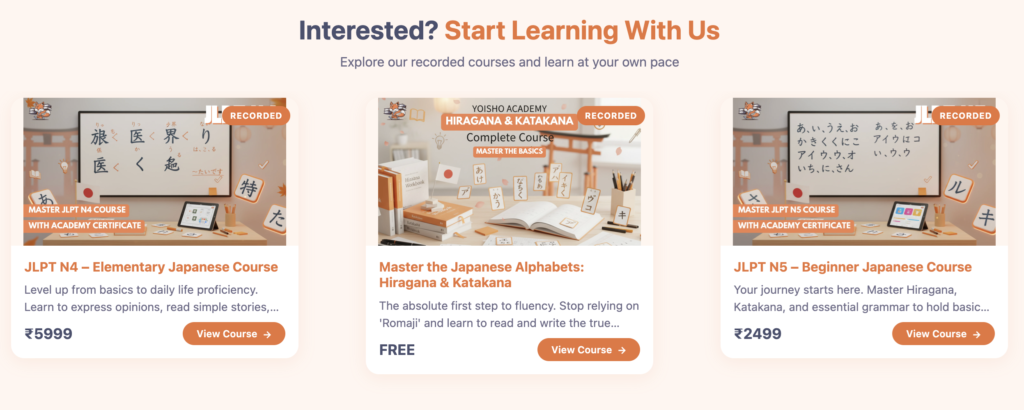
Mastering the Language: Yoisho Academy
Bhai, if you want to clear the JLPT, Yoisho Academy is the “ek number” way to do it. Designed to take you from “Zero to Hero,” this platform offers a streamlined, practical approach to Japanese for students and professionals alike.
- Live and Recorded Flexibility: Whether you thrive in real-time interaction or need to study at your own pace, Yoisho offers Live Interactive Batches and Self-Paced Recorded Modules. If you miss a live session, you can always catch up with high-quality recordings.
- Structured Study Material: The curriculum uses world-standard textbooks like Genki II, Sou Matome, and Minna no Nihongo. You don’t just get boring gyaan; you get structured notes, vocabulary flashcards, and unit quizzes that ensure the concepts stick.
- Comprehensive Preparation: From mastering Hiragana and Katakana to tackling the “Gold Standard” N2 or the elite N1, the courses include intensive kanji practice (up to 650+ for N3), weekly assignments, and full-length JLPT Mock Exams to ensure you are exam-ready.
- Expert Instruction: Learn from a mix of native Japanese instructors and certified experts who focus on purposeful strategies to tackle exam questions and real-world scenarios.
Visa Architectures: Navigating the Legal Path to Japan
Securing a job is only half the battle; the other half is obtaining the correct residence status. In 2026, the Japanese immigration system will offer two primary pathways for Indian professionals.
The Specified Skilled Worker (SSW / Tokutei Ginou) Visa
The SSW visa fills labour shortages in 16 specific fields (Nursing, Construction, Food Service, etc.).
- SSW Type 1 (SSW i): Entry point allowing up to five years of stay; family sponsorship is generally not permitted.
- SSW Type 2 (SSW ii): For highly skilled workers; has no limit on renewals and allows the worker to bring their family (spouse and children) to Japan.
The Engineer/Specialist in Humanities/International Services Visa
This is the standard visa for white-collar professionals, including IT engineers and marketers. It requires a bachelor’s degree or ten years of experience and mandates salary parity with Japanese employees.
Sectoral Deep-Dive: IT, AI, and the Indian Advantage
For the Indian tech community, Japan is a global hub for AI, semiconductors, and robotics. In 2026, the demand for specialists who can “connect technology to business outcomes” has driven salaries for senior experts to unprecedented levels. Indian engineers with backgrounds in VLSI design, mechatronics, and cloud architecture are highly valued. While English might suffice in some international startups, having JLPT N2 can increase job options by over 300%.
The Indori in Japan Job Matching Program: A "Zero to Hero" Framework
Recognizing the confusion many face when looking for jobs from India, Akash and the “Indori in Japan” team have developed a structured “Japan Job Match” system. This includes a 20-question eligibility quiz to provide an honest assessment of a candidate’s job prospects and personalised 1-on-1 career consulting. The program assists with resume optimisation (creating a Rirekisho), interview coaching on Japanese business etiquette, and access to unlisted job roles within their network.
Living the Dream: Realities of Life in Japan for Indians
Relocating from a city like Indore to a metropolis like Tokyo brings a “bhalti” (massive) set of changes. While safety and infrastructure are “ek number,” managing the cost of living requires discipline. Many Indians opt for “share houses” slightly outside the city centre to save on rent, taking advantage of the world-class railway system for which employers typically provide a full “commuter pass.”
Strategic Recommendations for Indian Aspirants (Careers in Japan 2026)
- Secure the Language Foundation: Enroll in a structured course at Yoisho Academy. Clearing N5/N4 in India is the minimum “bese” needed to apply for the SSW or entry-level IT roles.
- Target the “Salary Inflexion Point”: Aim for N2 to jump your earning potential by 40-70%.
- Utilise Professional Job Matching: Use structured platforms like the Japan Job Match app to avoid unreliable agents.
- Master “Reading the Air”: Understand that Japanese culture values non-verbal cues (kuki o yomu); observe and mimic native interactions.
Frequently Asked Questions (FAQs)
Q1. Is it possible to find a job in Japan without any JLPT certification?
Yes, in “English-only” IT roles or English teaching, but mobility is limited and traditional Japanese companies will be mostly inaccessible.
Q2. Can I move to Japan with my family on an SSW visa?
Only on SSW Type 2. SSW Type 1 holders generally cannot bring family members.
Q3. What is the “salary inflexion point” everyone talks about?
It is JLPT N2, the level where you transition from “semi-skilled” to “professional,” significantly increasing your salary in both India and Japan.
Q4. How long does the visa processing take from India?
The Certificate of Eligibility (COE) takes 1-3 months; once issued, the embassy visa takes 5-10 working days.
Q5. What are the best cities for Indians to work in Japan?
Tokyo, Yokohama, and Osaka offer the most vacancies, establishing Indian communities and vegetarian food options.
Conclusion
The 2026 Japanese labour market represents a “once-in-a-generation” alignment of economic need and cultural openness. For the Indian professional, the path is clear: invest in the language and choose the right visa pathway.
As Akash says, “If a regular guy from Indore can do it, so can you.” The reward—a stable, high-paying career in one of the world’s safest countries—is worth the “jugaad” today.
✍️ Bonus: Need Help Starting?
✅ Job hunting tips and real listings for foreigners in Japan
✅ Visa guidance made simple—no confusing search
✅ Resume & cover letter templates (Japanese & English formats)
✅ Life in Japan explained — from rent to ramen
✅ Travel guides & city recommendations for every kind of explorer
✅ Work culture insights to help you adjust and thrive



22 thoughts on “Is Learning Japanese Worth It? Comparing JLPT Levels and Income”
You did mention AI, data, and IT engineers are currently in demand, what about Green or Chemical Engineers, how viable are there jobs in Japan currently and will there be a demand in the future?
While IT gets the most noise, Green and Chemical Engineering are silent powerhouses in Japan. With Japan’s “2050 Carbon Neutral” goal, a massive Green Transformation (GX) is underway.
Current Viability: Huge demand in EV batteries, hydrogen fuel cells, and sustainable materials. Global giants like Mitsubishi Chemical and Sumitomo are actively seeking talent to lead their “decarbonization” efforts.
Future Demand: Growing rapidly. The government is investing trillions of yen into carbon capture and renewable energy infrastructure. This is a high-stability, high-growth career path.
The HSP Visa: Green engineers often qualify for the High-Skilled Professional visa, providing a faster 1–3 year route to Permanent Residency.
Language Requirement: These industries are more traditional than IT. You will almost certainly need JLPT N2 to handle technical safety protocols and corporate meetings.
Action Plan: Focus on companies involved in the “GX” initiative. Your skills in sustainable process engineering are a direct solution to Japan’s biggest environmental challenges.
For more info, Book a consultation now: https://topmate.io/indoriinjapan/1284640
I wanna know about job related to finance because I did b.com and I wanna know finance sector all job and their salary and how to do in detail … Only finance / commerce/account related job
As a B.Com graduate, you are eligible for high-paying roles in Japan’s global financial hub. Here is your quick guide:
1. Top Roles & Salaries (Annual)
Accountant/Auditor: ¥4M – ¥7M (₹22L – ₹40L). High demand in multinational firms.
Financial Analyst: ¥5M – ¥9M (₹28L – ₹51L). Focuses on market trends and corporate health.
Investment Banking (IB): ¥10M – ¥20M+ (₹57L – ₹1.1Cr+). High-pressure, high-reward roles in M&A and capital markets.
2. The Roadmap:
Language: This is non-negotiable for Finance. JLPT N2 is the minimum for entry; N1 is required for front-office banking/consulting.
Certifications: A CPA or CFA (Level 1+) acts as a major “salary multiplier.”
Target Companies: Start with “Gaishikei” (Foreign firms) like Deloitte, KPMG, or Goldman Sachs. They are more international-student friendly than traditional Japanese banks.
Pro-tip: Use your B.Com to apply for the “Specialist in Humanities” visa. Target Fintech startups if you want a faster, more modern work environment!
For more info, Book a consultation now: https://topmate.io/indoriinjapan/1284640
I’m 16 right now,and Will turn 17 this year, I’m a commerce without maths student,and learning japanese N5 lvl,is it possible for me to get a marketing job in japan? If I cleared N2-N1? And if my degree was B.a from english? If not which degree can I get? I’m in 12th this year.
It is absolutely possible! At 16, you have the perfect head start. Since you don’t have Maths, here is your strategy:
The Degree: While a B.A. in English works, a BBA or B.Com in Marketing/Management is much stronger. Japanese immigration prefers your degree to be directly relevant to your job field.
The Language: For Marketing, JLPT N2 is the minimum, but N1 is the target. Marketing is all about communication and understanding culture, so the higher your level, the higher your salary.
Maths vs. No Maths: Don’t worry. Most Marketing and Business degrees don’t strictly require 12th-grade Maths. Your creative and language skills are more valuable in this field.
Action Plan: Aim for a Business-related degree and try to reach N3 by the end of your first year of college.
Pro-tip: Look into “Global Marketing” roles where Japanese companies need help selling their products to the English-speaking world.
For more info, Book a consultation now: https://topmate.io/indoriinjapan/1284640
I am currently 16 years old and have just completed my 10th grade. I am planning to choose the Arts stream, and my goal is to pursue a BA (Hons) in Japanese.
I want to know if it is realistically possible to get a job in Japan after this, especially if I achieve JLPT N2 or N1. Also, can I apply for jobs directly from overseas, or is it necessary to be in Japan first?
My main question is about skills. Along with a BA in Japanese, which additional skill should I focus on to maximize my chances of getting a job in Japan? I want to choose one skill that is practical and in demand so that my chances are as high as possible.
At 16, you have a massive head start. Here is the direct path for an Arts student:
The Goal: A BA in Japanese + JLPT N2/N1 makes you a top-tier candidate.
The “Plus One” Skill: Since language is just a tool, pair it with Digital Marketing/SEO or UI/UX Design. Japanese firms are desperate for staff who can bridge the gap between Japan and global markets.
Overseas vs. Local: You can apply from India via sites like Daijob or LinkedIn, though many students enter via a Japanese language school first to network.
Timeline: Reach N4 by the end of 12th, and aim for N1 by your final year of college.
Action Plan: Focus on “Business Japanese” and get a professional certificate in marketing or design during your degree.
For more info, Book a consultation now: https://topmate.io/indoriinjapan/1284640
What about data analysts in japan
Do we get work with N3 certificate and data analytics
Or do we have to go for N2
Data Analysis is a hot field in Japan, but your JLPT level determines your target companies:
Pro-tip: Search for “Global Business” roles—they value your ability to handle international data and English skills more than N1 fluency.
For more info, Book a consultation now: https://topmate.io/indoriinjapan/1284640
Hi, I am in class 10 and I want to clear the board exam.I appeared for my Madhyamik (10th board exam) in February a few months ago. I want to go to Japan through the MEXT Scholarship, study there, build my career, and eventually work in Japan.
However, I am confused about which field I should choose in classes 11–12 so that I can have a better chance of going to Japan through the MEXT scholarship.
I am considering four different paths. Please tell me which one is more effective:
1)
I will study vocational Automobile in classes 11–12, then go to Japan and pursue B.Tech, and work in that field in Japan.
2)
I will study vocational Electrical in classes 11–12, then go to Japan through a scholarship and pursue B.Tech, and work in that field.
I have heard that for vocational students, one has to study in a KOSEN college in Japan. Please explain what this is and what opportunities are available in this field.
3)
I will study vocational Electrical or Automobile in classes 11–12, then after passing 12th, I will apply for MEXT scholarship in Animation, Manga Artist, or Anime Design field, and work in Japan in that field.
4)
I will study Math, Computer Science, Biology, and one more subject in classes 11–12. After passing higher secondary, I will go to Japan through MEXT and work in Computer Science.
If that doesn’t work, I will still take Math, Computer Science, Biology, and another subject in classes 11–12, then apply for MEXT in Animation, Manga Artist, or Anime Design field, and work in Japan.
Please suggest which field will increase my chances of getting the MEXT scholarship and help me settle permanently and work in Japan
Path 4 is your strongest route. Choosing Math, Physics, Chemistry, and Computer Science for 11th–12th provides the most flexibility and prepares you for the rigorous MEXT entrance exams.
Verdict: Take the Science stream. It keeps all doors open—from Computer Science to Animation—while ensuring you have the technical foundation Japan’s job market demands.
For more info, Book a consultation now: https://topmate.io/indoriinjapan/1284640
I am law student and recently I started jlpt preparetion for jlpt exam july but I have a doubt for the Job
How will I get a job in Japan as a foreign lawyer(gaiben)? What will I need? And what is its work and salary?
Becoming a Gaiben (Registered Foreign Lawyer) is a prestigious, high-paying path. Here is the breakdown:
Pro-tip: Join an international firm in India with a “Japan Desk” to facilitate an internal transfer to Tokyo.
For more info, Book a consultation now: https://topmate.io/indoriinjapan/1284640
Hlo bhaiya
I am currently 20 years old and I am a B Pharma student in my last year and I have also cleared the gate exam to do biochemical engineering in IIT and I have also cleared JLPT N3, is there any scope for it
Bhai, your profile is a powerhouse! Combining B.Pharma with Biochemical Engineering from an IIT and JLPT N3 puts you in the top 1% of candidates for Japan’s biotech sector.
1. The Industry Scope
Japan is home to pharma giants like Takeda and Astellas. They are shifting heavily toward Biologics and Gene Therapy, where your mix of pharmacy and engineering is a “unicorn” combination.
2. Visa & Salary
3. Language Goal
While N3 is a great start, the Pharma industry is traditional. Aim for N2 during your M.Tech to handle technical safety protocols and research documentation.
Action Plan: Focus your IIT research on Biopharmaceuticals and target the METI Internship to get corporate exposure in Japan before you graduate.
For more info, Book a consultation now: https://topmate.io/indoriinjapan/1284640
Hey their I am in field of semiconductor design (VLSI)
I was completed my master’s in India. I was been looking for opportunity in Japan. Because I would like to do phd and work parallel in this field. Is it possible whether you got anyone that achieve this moto.
This is 100% possible, and many Indian engineers achieve it. Japan is investing heavily in semiconductors (like TSMC and Rapidus projects) and faces a massive shortage of VLSI hardware talent.
You can pursue this through two main paths:
1. The Corporate Path (Company-Sponsored PhD)
Many Japanese semiconductor giants (like Sony, Renesas, or Tokyo Electron) hire Master’s graduates directly into R&D.
Once employed, companies often sponsor you for a Doctoral Program for Working Professionals (Shakaijin Dokutoru) at partner universities like Tokyo Tech or Tohoku University.
They cover your tuition while paying your full salary, and your corporate research double-hats as your PhD thesis.
2. The Academic Path (Joint Industry Projects)
Top universities run semiconductor consortiums directly tied to the hardware industry.
You enroll as a full-time PhD student but work on funded industrial research projects with semiconductor companies.
You receive a monthly research stipend/salary that covers your living costs while building industrial work experience.
Action Plan: Skip language barriers initially; VLSI is globally minded. Email semiconductor lab professors at top Japanese national universities directly with your Master’s portfolio.
For more info, Book a consultation now: https://topmate.io/indoriinjapan/1284640
Hello Bhai, I am currently 17 years old and studying diploma in agriculture my gpa is 7.8 currently and this is my final year but I want to study at waseda university for economics and have sufficient funds but if I get scholarship it will be best. I hadn’t done the 12th grade but will give ACT exam for waseda. Am I be able to study in Japan??
Bhai, yes, you can absolutely study at Waseda University! A 3-year Agriculture Diploma is generally recognized by the Japanese Ministry of Education as equivalent to 12 years of formal schooling.
Here is your quick roadmap:
1. The Admission Strategy
ACT Scores: Waseda’s Economics program (SPSE) is taught entirely in English. Because you are switching fields, aim for a high composite score (33+) with an exceptionally strong math score.
Verify Eligibility: Before applying, email Waseda’s International Admissions Office with your diploma transcript to officially confirm your 12-year equivalency.
2. The Language Factor
The Reality: While your degree is in English, you must learn Japanese to survive daily life and land high-paying corporate finance jobs in Tokyo by graduation.
How to Prepare: Apps won’t give you professional fluency. Get structured, live training through Yoisho Academy. They offer expert-led, interactive JLPT courses with small batches (10–12 students) to build real conversational and exam confidence before you land in Japan.
3. Scholarships & Funds
Waseda automatically evaluates international applicants for merit-based tuition reductions (20% to 100% off). Since you have sufficient funds, these reductions will serve as an excellent financial bonus.
Action Plan: Focus 100% on your ACT math prep, head over to yoisho.in to jumpstart your Japanese, and email Waseda to verify your diploma.
For more info, Book a consultation now: https://topmate.io/indoriinjapan/1284640
Hi, can’t reveal name right now, but i want to ask one thing.
I’m currently in class 12th and I’m a commerce without maths student ( with maths me fail ho sakta tha so risk nhi chahiye tha ).
I am planning to pursue ACCA after 12th along with b.com and I’ll try to reach JLPT N2 or N1 by when I’ll be becoming an ACCA member.
I don’t want any kind of roadmap regarding completing language, instead i want to ask that “which kind of softwares i should i learn before coming to Japan?” I’ll try to move Japan by the age of 26-27, so “what kind of experience should i actually try to get before coming to japan except language part?” Also please tell how can i get a employer from Japan who can sponsor my visa??
I want to apply for “FP&A Analyst” role in japan.
Pleasee help me out
Also plss tell expected salary of japan as an fp&a entry or staff level, if I’ve work experience of 2-3 years in India ( not in fp&a role but accounting experience ) i don’t think it’s valid that much but probably companies also want some kind of experience.