JPY 10 Trillion Investment: Everything You Need to Know About the Japan-India Mega Deal
皆さん、こんにちは!(Hello everyone!)
My friends, listen to me very carefully! If you are a software developer in Bangalore, a mechanical engineer in Indore, a startup founder in Tokyo, or a skilled professional looking to make a global move—this is the absolute blockbuster news flash of the decade. We are witnessing a monumental geopolitical and economic earthquake right now. The bridge between the land of the rising sun and the world’s fastest-growing tech powerhouse is officially open, and a staggering flood of cash, technology, and jobs is about to come your way!

We have some massive, breaking developments to talk about. Prime Minister Sanae Takaichi—Japan’s first female Prime Minister and a close strategic ally of the late, great Shinzo Abe—is arriving in New Delhi on July 1, 2026, for a highly anticipated three-day official visit. Takaichi is bringing a high-powered delegation of over 50 major Japanese companies. Their mission? To execute the historic India-Japan Joint Vision for the Next Decade.
This is not just another standard diplomatic handshake, my friends. This is a full-scale, synchronized economic, technological, and defence alignment. With Japan facing a severe labour shortage and India emerging as a global high-tech manufacturing and design powerhouse, the opportunities for you are simply unbelievable.
Let us break down every single juicy detail of this megadeal and look at exactly how you can position yourself to ride this massive wave!
The JPY 10 Trillion Cash Wave: Japan’s Ultimate Bet on India
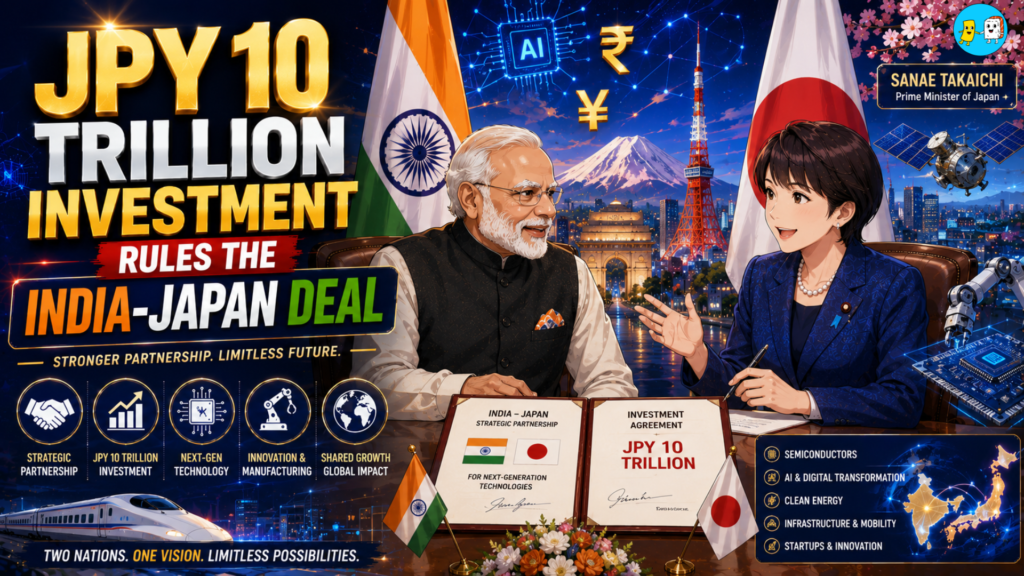
Let’s talk about the absolute jaw-dropping numbers first! Under this newly finalised decade-long roadmap, Japan has committed to a massive target of JPY 10 trillion (approximately USD 67.6 billion) in private sector investments directly into India.
THE INVESTMENT LEAP: JAPAN’S PRIVATE CAPITAL FLOOD
- Previous Target (2022–2026): JPY 5 Trillion (Achieved!) ──► Public-Private Soft Loans
- New Target (Next Decade): JPY 10 Trillion (~$67.6B) ──► Pure Private Venture Capital & JVs
Now, why is this target so historic?
- It is purely private-sector-led: The previous JPY 5 trillion target set for 2022–2026 relied heavily on public infrastructure loans and was achieved in just three years. Now, the floodgates are open for massive private-sector venture capital, commercial joint ventures, and direct technology transfers.
- Unparalleled Profitability: According to the latest surveys, India ranks as the single most promising destination for Japanese companies looking to expand overseas. In fact, an incredible 77.7% of Japanese firms already operating in India are reporting high profitability!
- Removing Bureaucracy: To ensure this capital flows without friction, the bilateral partners have established the India-Japan Small and Medium Enterprises Forum and a dedicated Japan Plus Desk within India’s Department for Promotion of Industry and Internal Trade. This means mid-sized Japanese tech and engineering firms can set up local hubs in India with absolute ease, removing red tape in real-time.
The Economic Security Initiative: Shielding the Tech of Tomorrow
My friends, in the modern world, national security is no longer just about borders—it is about securing your microchips, your clean energy, and your critical minerals. This is why the launch of the India-Japan Economic Security Initiative is such an absolute game-changer.
To supervise these massive joint projects, the formal India-Japan Economic Security Dialogue held its second major round in New Delhi on May 11, 2026, co-chaired by Foreign Secretary Vikram Misri and Japanese Vice Ministers Takehiro Funakoshi and Takehiko Matsuo. They have locked in five highly critical strategic sectors for immediate execution:
1. Semiconductors and Electronics
Japan is a global titan in semiconductor manufacturing equipment and specialised raw materials, while India has the world’s most powerful pool of chip design talent. Rather than just talking, they are executing! Major Japanese giant Renesas has officially partnered with India’s Centre for Development of Advanced Computing (C-DAC) under the Chips to Startup program to co-develop semiconductor designs and set up local manufacturing facilities right in India!
2. Critical Minerals Sovereignty
This is a massive strategic move. India’s Ministry of Mines, led by Minister G. Kishan Reddy, and Japan’s Ministry of Economy, Trade and Industry (METI) have signed a landmark Memorandum of Cooperation (MoC). The target? To completely bypass vulnerable single-source suppliers and secure independent supply chains for lithium, cobalt, and rare earth elements. For example, Toyota Tsusho has already expanded its massive rare earth refining facility in Andhra Pradesh to supply critical materials for electric vehicles and advanced defence systems!
3. Secure Future Networks (6G and AI)
Under the Digital Partnership 2.0, India and Japan are pouring massive R&D funds into secure telecom networks, Artificial Intelligence, and Internet of Things architectures. The Japan-India AI Cooperation Initiative is actively bridging academic and startup ecosystems in both countries to create a highly secure, trustworthy AI framework.
4. Clean Energy and Decarbonization
Say hello to the Sustainable Fuel Initiative and the Joint Crediting Mechanism (JCM). Japan is transferring cutting-edge decarbonization technologies to India, including clean hydrogen and ammonia projects. Right now, IHI Corporation and Adani Power are running an actual ammonia co-firing demonstration at the Mundra Power Plant in Gujarat to show the world how green transition is done!
The UNICORN Stealth System & The Lethal Arms Export Overhaul
This is the absolute most sensational part of this new era! The geopolitical realities of the Indo-Pacific have forced India and Japan to upgrade their defence ties to a level never seen before.
THE UNICORN NORA-50 STEALTH ADVANTAGE
- Traditional Warship: Multiple scattered antennas ──► High Radar Signature (Easy to detect)
- UNICORN System: All antennas in one stealth FRP dome ──► Low Radar Cross Section (Nearly invisible)
The Stealth Antenna Revolution
India and Japan have signed a historic agreement for the co-development of the Unified Complex Radio Antenna (UNICORN) mast system (Nora-50) for the Indian Navy. Developed by Japan’s NEC Corporation, Yokohama Rubber, and Sampa Kogyo, this represents top-tier, weapon-grade naval technology.
Currently installed on Japan’s ultra-modern Mogami-class frigates, the UNICORN system consolidates all communication, radar, and electronic warfare antennas into a single, horn-shaped mast enclosed in a high-tech Fibre Reinforced Plastic (FRP) radome. This offers unbelievable advantages:
- Near-Invisibility: By removing scattered deck antennas, it dramatically lowers the Radar Cross Section (RCS) of warships, making them incredibly difficult for enemy sensors to track.
- Zero Signal Interference: It eliminates mutual electronic interference among closely packed systems, giving commanders flawless, high-speed communication in the heat of battle.
- Battlefield Resilience: It features integrated lightning diverters to protect sensitive electronics, and the entire composite mast can be swapped out as a single unit for rapid, on-site repairs.
Under this deal, Bharat Electronics Limited (BEL) will co-produce and integrate these stealth masts directly in India, marking an immense victory for the ‘Make in India’ defence initiative!
Prime Minister Takaichi Ends the Arms Export Ban
On April 21, 2026, the Japanese cabinet under Prime Minister Sanae Takaichi shook the global defence community by officially ending Japan’s decades-old ban on the export of finished lethal weapons and technology transfers to 17 allied countries with defence pacts—including India!
Previously, Japan could only export non-lethal, defensive equipment. Now, the Takaichi administration can directly export warships, fighter jets, missiles, and advanced drones. In fact, reports indicate that Japan has already offered India its advanced designs for the Mogami-class stealth frigates, with plans to construct them right in Indian shipyards!
This defence diversification is highly critical for India’s military planners. During the recent, highly consequential Operation Sindoor—launched by India following terror attacks in Pahalgam—the Indian military observed extensive deployment of advanced Chinese-origin fighter jets, radar systems, and real-time electronic surveillance by adversary forces. This has accelerated India’s strategic push to diversify away from its legacy reliance on Russian hardware and integrate state-of-the-art, highly reliable Japanese electronic systems.
The Talent Highway: 500,000 People Exchanged
Listen up, because this is where your life could change completely! To solve Japan’s severe labour shortages and utilise India’s massive, highly skilled young workforce, both nations have launched the Action Plan for India-Japan Human Resource Exchange and Cooperation.
They have set an absolute blockbuster target of exchanging 500,000 personnel over the next five years, which includes a dedicated target of sending 50,000 highly skilled Indian professionals directly to live and work in Japan!
The main official pathways are highly structured and ready for you to use:
- The Specified Skilled Worker (SSW) System: Spanning 16 critical industrial sectors, Japan is rapidly establishing official language and skills testing centres across all regions of India.
- The Technical Intern Training Program (TITP): Providing direct, hands-on vocational internships inside top Japanese manufacturing facilities and assembly lines.
- The India-Nippon Programme for Applied Competency Training (INPACT): Funding vocational training, language academies, and Japanese-endowed engineering courses inside Indian academic institutions, so you are job-ready before you even graduate.
- The MIRAI-Setu & MEXT Scholarships: Offering short-term, fully-funded internships for Indian IT and engineering students directly inside high-tech Japanese startups.
Core Quantitative Metrics of the India-Japan Corridor
Here is the absolute source of truth, summarising all the massive statistical targets, financial commitments, and strategic sectors of this bilateral corridor in a single consolidated table:
| Domain / Initiative | Key Parameter / Metric | Target Value / Status | Strategic Implications & Impact |
|---|---|---|---|
| Bilateral Investment | Private Sector Direct Investment | JPY 10 Trillion (~USD 67.6 Billion) | Replaces the successfully achieved JPY 5 trillion target. |
| FDI Equity Inflows | Cumulative Japanese Investment (2000–2025) | USD 44.39 Billion | Solidifies Japan as India's 5th largest source of FDI. |
| Corporate Footprint | Registered Japanese Companies in India | ~1,500 (5,000 Establishments) | Over 50% are focused on advanced manufacturing. |
| Bilateral Trade | Total Trade Volume (FY 2024–2025) | USD 25.17 Billion | Balance of high-tech imports and organic exports. |
| Human Capital | Total 5-Year Personnel Exchange Target | 500,000 Exchanges | Massive bilateral academic, student, and tourist push. |
| Skilled Migration | Indian Professionals Migrating to Japan | 50,000 Skilled Workers | Fast-track career visas across 16 critical sectors. |
| Digital Integration | Cross-Border Payments Solution | UPI-to-Japan Network Link | NTT Data and NIPL are connecting real-time payments. |
| Regional Development | Northeast India Funding (Assam Guwahati Water) | ₹1,736 Crore JICA Loan | Providing clean water to 140,000 households. |
| Defense Co-Production | UNICORN Stealth Antenna Integration | Active Execution Phase | Co-developed by BEL and Japanese defence consortia. |
| Critical Minerals | Import Dependency Sourcing (Lithium/Rare Earths) | 80% to 90% Import Reliance | Targeted for diversification via the Mines-METI MoC. |
WHAT DOES THIS MEAN FOR YOU? (Your Ultimate Call to Action)
My friends, a historic opportunity like this does not knock on your door twice! Here is exactly how you can take action right now to change your career and business trajectory:
Are You a Software Developer or IT Professional?
- The Opportunity: Under the Digital Partnership 2.0 and the Japan-India AI Cooperation Initiative, Japanese tech giants and deep-tech startups are desperately looking for Indian coding talent to build the systems of tomorrow.
- Your Action Plan: Do not wait! Start learning basic Japanese immediately (aim for the JLPT N4 or N5 level). Register on India’s official e-Migrate portal and check the dedicated India-Japan corridor on the National Career Service platform to get matched directly with certified, high-paying Japanese employers!
Are You a Mechanical, Manufacturing, or Electronics Engineer?
- The Opportunity: With Japan co-producing the UNICORN stealth mast in India via BEL and setting up massive high-tech semiconductor and automotive hubs, the demand for core engineering specialists is reaching an all-time high.
- Your Action Plan: Look for Japanese Endowed Courses (JEC) inside Indian engineering universities or apply for professional work visa sponsorship with companies operating under the Japan Plus Desk.
Are You a Student, Researcher, or Academic?
- The Opportunity: Fully-funded academic research positions, the prestigious MEXT scholarships, and the brand-new MIRAI-Setu program are offering month-long, paid internships inside Japan’s top high-tech laboratories.
- Your Action Plan: Contact your university’s international relations department today and ask about active exchange programs with Japanese universities. Focus your research on semiconductors, Artificial Intelligence, clean hydrogen, or critical mineral recycling.
Are You an Entrepreneur or Business Owner?
- The Opportunity: With JPY 10 trillion in private capital flowing, Japanese companies are looking for reliable local partners, downstream component suppliers, and distributors across India.
- Your Action Plan: Connect with the India-Japan Small and Medium Enterprises Forum. If you are in the green energy, telecom, pharmaceutical, or advanced components sectors, align your business with the standards set by the Japan Plus Desk to secure direct joint-venture funding!
FAQs: Your Questions Answered
Q1) How can I apply to work in Japan under the India–Japan human-resource exchange?
Under the Action Plan for India–Japan Human Resource Exchange and Cooperation (announced August 2025), Japan plans to take in around 50,000 skilled and semi-skilled Indian personnel over five years, as part of a larger two-way exchange of 500,000 people between the two countries. These are targets rather than a fixed number of vacancies, and recruitment is expected to roll out gradually.
You can apply through official, secure government channels. The primary pathways are India’s e-Migrate portal, where Japan has been added as a destination country, and the dedicated India–Japan corridor on the National Career Service (NCS) platform, which matches certified candidates with verified Japanese employers.
Most workers in this stream enter on the Specified Skilled Worker (SSW) visa. To qualify, you typically need to pass a practical, sector-specific skill exam and a basic Japanese-language test (JLPT N4 or JFT-Basic). Note that candidates who have already completed Japan’s Technical Intern Training Programme (TITP) may be eligible for exemptions from these tests.
Q2) What makes the UNICORN mast system so special compared to traditional warship antennas?
Traditional warships have multiple separate antennas scattered across the deck, which creates a massive radar signature and causes electronic signal interference. The UNICORN mast system (Nora-50) consolidates all communication, radar, and electronic warfare systems into a single, highly streamlined mast enclosed in a weather-resistant Fibre Reinforced Plastic dome. This drastically minimises the warship’s Radar Cross Section, making it nearly invisible to enemy sensors.
Q3) What is the Economic Security Initiative, and how does it protect India and Japan?
The Economic Security Initiative is a joint governmental framework designed to build resilient supply chains in critical sectors like semiconductors, critical minerals, clean energy, telecom, and pharmaceuticals. By co-locating manufacturing facilities, pursuing joint mining exploration, and aligning technology standards, it ensures both nations are shielded from global supply chain shocks, economic coercion, and reliance on single-source suppliers.
Q4) Why is Japan investing so heavily in infrastructure in Northeast India?
Northeast India holds a highly sensitive, strategically vital geographical position bordering China, Myanmar, Bangladesh, and Bhutan. Working through the Act East Forum, Japan is the premier foreign partner permitted to invest in and develop infrastructure in this region. Projects like the JICA-funded roads and the ₹1,736 crore Guwahati Water Supply Project enhance local economic modernisation, connect the region to wider Southeast Asian trade routes, and strengthen the overall economic resilience of India’s borderlands.
Q5) Do I need to speak fluent Japanese to get a high-paying job under this partnership?
Absolutely not! While high-end management roles require business-level Japanese, most tech, nursing, and manufacturing jobs under the Specified Skilled Worker (SSW) visa only require conversational Japanese (JLPT N4 or JFT-Basic). For top-tier IT and research professionals with direct company sponsorship, English is widely used in the workplace, though learning basic Japanese is highly recommended for daily life in amazing hubs like Nishi-Kasai!
Conclusion: Shaping the Next Decade Together
My friends, the India-Japan partnership is no longer just a collection of standard diplomatic files. It has evolved into an integrated, high-vibe strategic corridor that combines Japan’s advanced technology, massive capital reserves, and defence expertise with India’s immense scale, design talent, and youthful energy.
As Prime Minister Sanae Takaichi arrives in New Delhi, the blueprint for the next ten years is officially operational. The supply lines are being secured, the factories are being built, and the jobs are ready for the taking. Do not sit on the sidelines while history is being written. Get ready, build your skills, and take your place in this incredible global corridor today!
✍️ Bonus: Need Help Starting?
✅ Job hunting tips and real listings for foreigners in Japan
✅ Visa guidance made simple—no confusing search
✅ Resume & cover letter templates (Japanese & English formats)
✅ Life in Japan explained — from rent to ramen
✅ Travel guides & city recommendations for every kind of explorer
✅ Work culture insights to help you adjust and thrive