Japan New Residence Card Is Changing From June 14, 2026: What Every Foreigner Living in Japan Needs to Know
皆さん、こんにちは!(Hello everyone!)
Welcome back to the ultimate resource for your journey in Japan! If you are currently living in Japan, planning to relocate here, or trying to establish your long-term career in this beautiful country, you have landed in the absolute right spot.

We are talking about a monumental, system-wide shift that goes live tomorrow, June 14, 2026. This is not just a minor administrative update; this is the most massive overhaul of Japan’s foreign resident documentation and administrative landscape in more than a decade.
Starting tomorrow, the Immigration Services Agency of Japan is officially rolling out the brand-new Specified Residence Card, known structurally as the Tokutei Zairyu Card. This new physical card integrates your standard Residence Card and your My Number Card into a single, highly secure plastic document containing an advanced, unified IC chip.
At the same time, a complete visual redesign is taking effect for all standard Residence Cards. Whether you choose to merge your cards or keep them separate, the way your identity is verified in Japan is changing forever. Let’s dive into every detail of this program so you do not get caught off guard by the new rules, timelines, or massive updated fee structures!
What is the Specified Residence Card (Tokutei Zairyu Card)?
- The Consolidated Digital ID: Under the amended Immigration Control Act passed by the Diet, the Tokutei Zairyu Card is a voluntary, combined physical credential designed to simplify public administration for foreign residents.
- The Integration Strategy: This transition represents the third stage of Japan’s digital modernization. Following the complete phase-out of health cards in late 2024 and driver’s license integration in early 2025, the foreign resident population is now fully incorporated into the unified national identification system.
- Myna Hokensho and Driver’s License Capabilities: Legally treated as a My Number Card, this combined document functions as your digital health insurance card (Myna Hokensho) and can also be registered to function as a digital driver’s license.
- Moving Details Off the Card Face: To protect personal privacy and prevent counterfeiting, critical details like your visa type, period of stay, approval date, and card issuance date will be completely removed from the visible front of the card. Instead, this data will live exclusively inside the secure IC chip.
- The Backside Display: Your twelve-digit Individual Number (My Number) will be printed on the reverse side of the card, but this layout is strictly limited to those who choose the integrated Tokutei card. Standard, non-integrated cards will continue to leave this field blank.
Why is this Card Integration a "Golden Ticket" for Foreign Residents?
- Eliminates Double Visits: Previously, any visa update required a trip to the immigration office, followed by a separate trip to your municipal ward office to update your My Number Card. This integrated card synchronizes automatically, saving hours of public transit and paperwork.
- Faster Relocation Procedures: When you change apartments or move to a new city, municipal clerks can update your address on both systems simultaneously in a single, streamlined transaction.
- Strengthened Personal Security: Having your exact visa expiry and residence status hidden from the physical face of the card ensures that random third parties cannot scrutinize your immigration details during routine ID checks.
- Seamless Digital Government Access: The digital certificate stored on the secure chip allows you to log into the Mynaportal app to request tax documents, pension records, and official residency files directly from your smartphone.
- Quick Bank and Mobile Registrations: Setting up bank accounts or securing mobile phone contracts will become much cleaner as commercial entities utilize secure chip readers to verify your legal status instantly.
Who Can Apply? (Eligibility for Specified Residence Card)
- Mid-to-Long-Term Residents: Only foreign nationals legally residing in Japan for the mid-to-long term and registered in the municipal Basic Resident Register are eligible.
- Special Permanent Residents: You are fully eligible to apply for the equivalent Tokutei Special Permanent Resident Certificate at your municipal city hall.
- Exclusion of Short-Term Visas: If you hold a tourist visa, temporary visitor visa, diplomat status, or have a stay period of 3 months or less, you are completely ineligible for this program.
- In-Country Processing Only: You may only apply for this card integration when undergoing an active, in-country immigration procedure in Japan.
- No Airport Deliveries: You cannot receive an integrated Specified Card directly at the airport upon arrival. Airports strictly issue standard cards, as municipal address registration must occur first.
Official Website: Immigration Services Agency of Japan
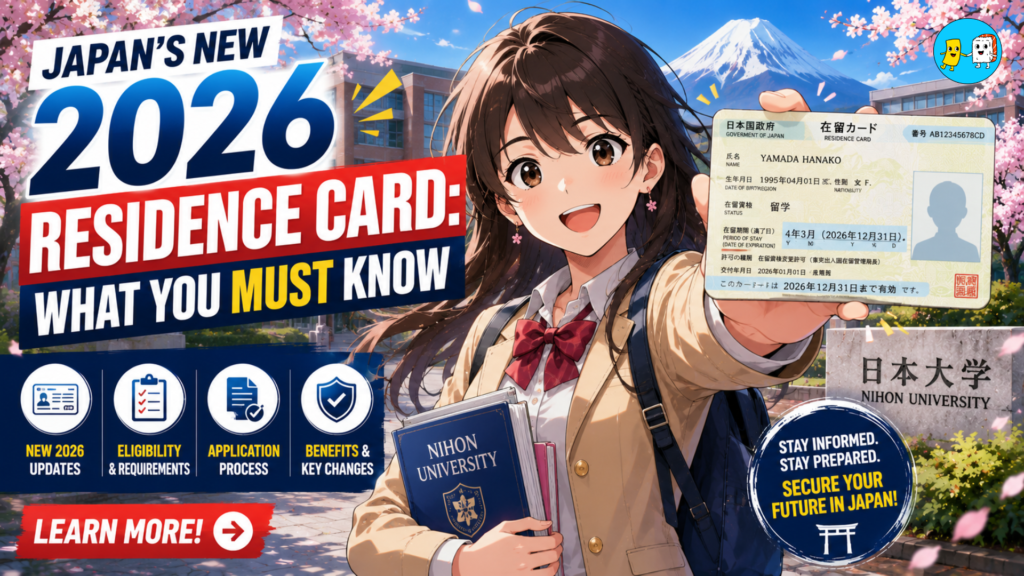
The Stats: All Cards and Fee Changes at a Glance (Japan New Residence Card)
The Japanese Diet recently passed a historic bill dramatically raising the statutory ceilings for immigration procedures to fund modernisation, local integration support, and administrative services. This table compares the visual, structural, and financial metrics across the card systems starting tomorrow:
| Administrative and Financial Metrics | Legacy Card System (Issued Up to June 13, 2026) | New Standard Format (Second-Generation, From June 14, 2026) | Specified Card Format (Tokutei Zairyu Card, From June 14, 2026) |
|---|---|---|---|
| Official Nomenclature | Mandatory for all | Mandatory for non-integrated options | Completely voluntary |
| My Number Integration | A separate physical card is required | A separate physical card is required | Integrated onto one secure IC chip |
| Visual Details on Card Face | Printed on front | Stored in an IC chip only | Stored in an IC chip only |
| My Number Display | Not printed on reverse | Not printed on reverse | Printed on the reverse side |
| Photo Mandate for Minors (Ages 1–15) | Exempt (Only 16 and older require photos) | Mandatory | Mandatory |
| Permanent Resident Card Expiry | 7 years | 10th birthday (5th birthday if under 18) | 10th birthday (5th birthday if under 18) |
| Card Issuance Timeline | Same-day at the counter | Same-day at the counter | Extra 10-day processing delay |
| Airport Port of Entry Availability | Available at major airports | Available at major airports | Not available at airports |
| Immigration Integration Fee | Free for basic card | Free for basic card | 1,900 JPY (2,600 JPY for direct home mailing) |
| J-LIS Verification Fee | N/A | N/A | 600 JPY (800 JPY for electronic certificate) |
| Single-Entry Tourist Visa Fee | 3,000 JPY | 15,000 JPY (Effective April 2026) | 15,000 JPY (Effective April 2026) |
| Multiple-Entry Tourist Visa Fee | 6,000 JPY | 30,000 JPY (Effective April 2026) | 30,000 JPY (Effective April 2026) |
| International Departure Tax | 1,000 JPY | 3,000 JPY (Effective July 1, 2026) | 3,000 JPY (Effective July 1, 2026) |
| Extension/Change Fee (Up to 3 Months) | 6,000 JPY | ~10,000 JPY (Enacted May 2026) | ~10,000 JPY (Enacted May 2026) |
| Extension/Change Fee (1 Year) | 6,000 JPY | ~20,000–30,000 JPY | ~20,000–30,000 JPY |
| Extension/Change Fee (3 Years) | 6,000 JPY | ~60,000 JPY | ~60,000 JPY |
| Extension/Change Fee (5 Years) | 6,000 JPY | ~70,000 JPY | ~70,000 JPY |
| Permanent Residency Fee | 10,000 JPY | ~200,000 JPY (Up to 300,000 JPY legal limit) | ~200,000 JPY (Up to 300,000 JPY legal limit) |
The Application Roadmap: Step-by-Step Guide (Japan New Residence Card)
Step 1: Complete Address Registration and My Number Setup
If you are newly arrived, you must register your address at your local municipal office within 14 days of moving in. This triggers the mailing of your Individual Number Notice. If you do not have a My Number Card yet, use the QR code on your notice letter to apply online. The card takes about a month to arrive and is a mandatory prerequisite for obtaining the integrated card.
Step 2: Collect the Required Documentation
When preparing for your next in-country immigration procedure, gather the following physical files:
- The official application form for the Tokutei Zairyu Card (Tokutei Zairyu Card Kofu Shinsho).
- The PIN and password setup request form (Ansho Bango Settei Iraisho).
- One passport-style ID photo (4 cm × 3 cm) taken within the last six months.
- Your current physical Residence Card and a valid passport.
- Note for Families: For children aged 1 to 15, actual photo submissions are now strictly mandatory for all newly issued, renewed, or reissued cards. The online immigration system will no longer accept the “photo not required” placeholder for this age group.
Step 3: Submit to the Immigration Bureau in Person
Take your completed package to the Regional Immigration Bureau holding jurisdiction over your registered address. At the counter, you will submit biometric fingerprints and your electronic signature. Because of security protocols, proxy or online submissions for the combined card are not accepted during the initial rollout.
Step 4: Manage the Synchronisation Delay and Retrieve
Because your card requires a direct data handshake between local municipal servers, J-LIS databases, and the Immigration office, it cannot be issued instantly. The integration process takes approximately 10 days longer than a standard Residence Card. Once notified, return to the immigration bureau, input your chosen numeric PIN codes at the terminal to activate your card, and retrieve your integrated document.
The Operational Realities of the New Card Format (Japan New Residence Card)
- Verification Issues in the Private Sector: Because the new standard and integrated cards omit your visa type and period of stay from the card’s face, private entities—including banks, credit card providers, landlords, and mobile companies—will face verification hurdles. These companies will be forced to use secure IC readers or municipal verification apps, which will likely prolong wait times.
- The Logistical Travel Trap: The ten-day processing delay is a critical risk factor if you have upcoming international travel plans. Legally, you are strictly barred from departing Japan under the Special Re-entry system if you do not physically possess your active card. Do not initiate card integration right before a scheduled flight!
- Stricter Socio-Economic Compliance Audits: Merging your cards means your physical residency status is directly linked to your real-time tax, national pension, and health insurance contribution records. Under the updated guidelines, foreign residents with unpaid municipal taxes or missed insurance premiums face immediate visa renewal rejections. Furthermore, having unpaid medical bills exceeding 10,000 JPY will make you ineligible for visa renewal, making financial compliance an absolute prerequisite.
- Ward Office Address Update Backlogs: Whenever you move and register a new address, municipal clerks must physically write the new details onto your integrated card’s secure IC chip. This technological step is projected to significantly increase counter processing times, leading to longer lines and backlogs at city halls, especially during the high-volume relocation months of March and April.
Frequently Asked Questions (FAQs)
Q1. Is the transition to the Specified Residence Card mandatory?
No, transitioning to the integrated Tokutei Zairyu Card is completely optional. Foreign residents can maintain separate Residence Cards and My Number Cards if they prefer. Any standard Residence Card issued before June 14, 2026, remains completely valid until its printed expiration date.
Q2. Why does the Tokutei Zairyu Card take 10 days longer to process?
The ten-day delay is due to the mandatory data synchronisation process between the Immigration Services Agency and the Local Authorities Systems (J-LIS). The immigration office must cross-reference and verify your personal records across different municipal networks before finalising and locking the IC chip.
Q3. Can newly arrived foreign residents receive the integrated card at the airport?
No, the integrated Tokutei Zairyu Card cannot be issued at any port of entry or airport in Japan. When entering the country, eligible airports will strictly issue standard, new-format Residence Cards. You must register your address at your local municipal ward office, get your My Number notice, and apply for the integrated card during a future in-country immigration procedure.
Q4. What is the process if my integrated Tokutei Zairyu Card is lost or stolen?
If your card is lost or stolen, you must execute a strict security protocol immediately:
- File a formal loss report at the nearest police station to obtain a police report number.
- Contact the national hotline immediately to temporarily suspend your card’s active My Number and digital certificate capabilities to prevent identity theft.
- Visit the regional immigration bureau to apply for a standard replacement Residence Card. Because they cannot generate integrated cards instantly, they will issue a standard card first. You can apply to merge the cards again during a later procedure.
Q5. Do the new, massive visa fee increases apply to the integrated card itself?
No. The standard integration process only requires the baseline handling fee of 1,900 JPY (or 2,600 JPY for home mailing) plus the municipal J-LIS fee of 600 to 800 JPY. However, if you apply for integration concurrently with a visa renewal or change of status, you must pay the newly restructured, tiered immigration processing fees (ranging from 10,000 JPY to 70,000 JPY depending on the length of stay granted).
Conclusion: Preparing for the Digital Shift
The rollout of the Specified Residence Card and the visual redesign of all Residence Cards starting tomorrow represent a permanent, digital shift in how Japan manages its foreign population. By unifying immigration, municipal records, tax data, and health insurance, the Japanese government is building a highly synchronised system.
While this means fewer office visits and less physical paperwork for us, it also means that maintaining clean financial records, paying municipal taxes on time, and tracking your visa expiration dates are more important than ever. Be proactive, manage your documents early, calculate your tiered fees, and make informed choices to ensure your journey in Japan remains smooth and successful!
Official Website: Immigration Services Agency of Japan
✍️ Bonus: Need Help Starting?
✅ Job hunting tips and real listings for foreigners in Japan
✅ Visa guidance made simple—no confusing search
✅ Resume & cover letter templates (Japanese & English formats)
✅ Life in Japan explained — from rent to ramen
✅ Travel guides & city recommendations for every kind of explorer
✅ Work culture insights to help you adjust and thrive