Tohoku University Exchange Program 2026: Get Full Tuition Waivers and 80,000 JPY Monthly Stipends
皆さん、こんにちは!(Hello everyone!)
Tohoku University, located in the historic and vibrant city of Sendai, maintains a position of preeminence within the Japanese and global academic landscapes. As one of the original Imperial Universities of Japan, it has long operated under the guiding principles of “Research First,” an “Open Doors” policy, and “Practice-Oriented Research and Education”. These foundational pillars have not only shaped the university’s internal culture but have also defined its approach to international exchange, making it a primary destination for scholars seeking rigorous scientific training and cultural immersion. The institution’s recent designation as Japan’s first “University for International Research Excellence” in December 2024 underscores its trajectory toward becoming a world-leading research hub, supported by significant government investment and a renewed focus on global brain circulation.

Institutional Prestige and Global Performance Metrics
The institutional standing of Tohoku University is validated by its consistent performance in international ranking systems. As of the 2025 and 2026 academic cycles, the university is ranked among the top 110 institutions globally by QS and maintains a top-tier status in Asia. Its academic reputation is particularly strong in STEM fields, where it leverages advanced facilities like the NanoTerasu synchrotron radiation facility to produce high-impact research. The university’s commitment to diversity is evidenced by its enrollment of approximately 2,200 international students out of a total population of 18,000, representing a significant percentage of the graduate and research-level cohorts.
Programmatic Architecture: The Four Pillars of Exchange
The research exchange framework at Tohoku University is categorised into four primary programs, each catering to different academic levels, linguistic capabilities, and research objectives. These programs—JYPE, COLABS, IPLA, and DEEP—are designed to integrate international students into the university’s research-intensive environment with varying degrees of structural support.
Junior Year Program in English (JYPE)
JYPE is specifically tailored for third- or fourth-year undergraduate students in science, engineering, and agriculture. The core of this program is the “Individual Research Training” (IRT) course, where students conduct research on a specific topic under the guidance of a faculty member. This model emphasises practical laboratory experience, allowing students to contribute to ongoing research projects while earning at least 13 credits per semester. The linguistic barrier is minimised as the program is conducted entirely in English, though it encourages the study of the Japanese language and culture through elective courses.
Cooperative Laboratory Study Program (COLABS)
COLABS is a graduate-level program (Master’s or Doctoral) that provides high-quality research training in natural sciences. It spans departments such as Medicine, Dentistry, Pharmaceutical Science, Engineering, Information Sciences, and Environmental Studies. A defining characteristic of COLABS is its high acceptance rate—93% in 2023—which reflects the rigorous pre-screening process known as “Prior Consent”. Completion of the program requires students to fulfil the equivalent of 30 ECTS credits per semester, typically involving a substantial research report of 30–40 pages for long-term participants.
International Program in Liberal Arts (IPLA)
Focusing on the humanities and social sciences, IPLA welcomes sophomores and juniors to engage in courses taught in English across disciplines like economics, management, law, and literature. While research is not the primary focus for undergraduates in IPLA, the program values cultural exchange and provides significant support for Japanese language acquisition. Graduate students in similar fields may enroll through the DEEP-Bridge or direct enrollment schemes to conduct interdisciplinary research with Tohoku University professors.
Direct Enrollment Education Program (DEEP)
DEEP is designed for students who possess advanced Japanese language proficiency (JLPT N1). It allows for direct enrollment in STEM courses alongside Japanese students, facilitating a fully integrated academic experience. This program is ideal for those who wish to experience the Japanese pedagogical style first-hand and participate in laboratory life without the “protective” shell of English-mediated programs.
The "June–October" Timeline: A Strategic Preparation Window
While the formal application period for the Fall intake (October enrollment) typically occurs from January 10 to February 20, the period from June to October represents a critical window for two distinct groups of researchers. First, for students already enrolled in the Spring semester, this window marks the transition toward the latter half of their research exchange. Second, and more importantly, for those seeking “Research Student” (non-exchange) status or “Special Research Student” status, June through October is the active recruitment and application phase for the following academic year.
For regular exchange applicants, the June–October period is the primary time for “prior consultation.” Prospective graduate researchers in the COLABS program are advised to begin identifying potential supervisors and initiating contact during these months. This early engagement is essential for securing the “Prior Consent” required before the formal TAO system opens in January. Furthermore, summer research internships such as T-SRIP (Tohoku University STEM Research Internship Program) operate within the June–August window, providing a condensed version of the research experience.
Financial Framework: The "Free" Application and Stipend Availability
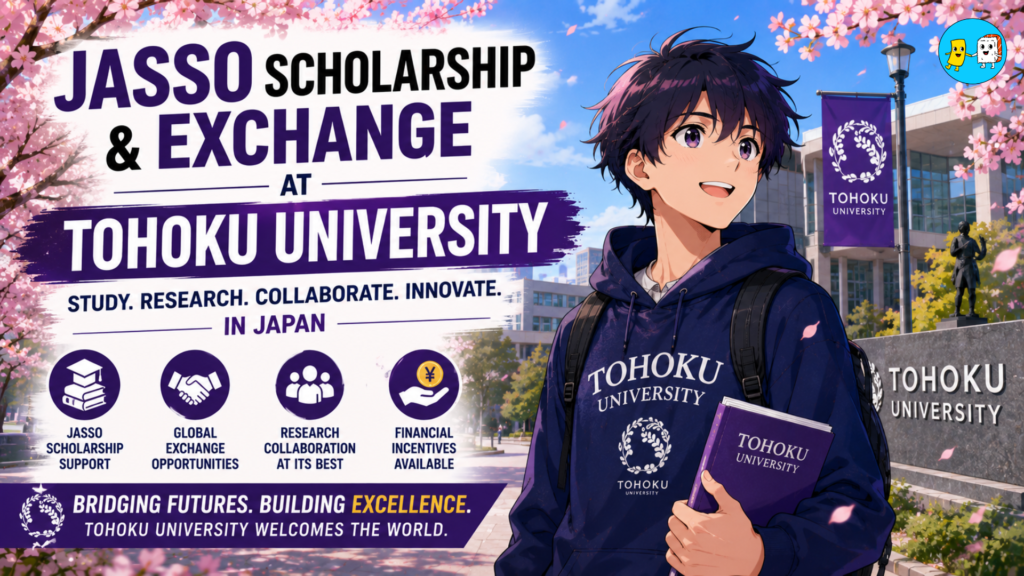
One of the most attractive features of the Tohoku University research exchange is the elimination of financial barriers for students from partner institutions. Under the standard Memorandum of Understanding (MOU), exchange students are eligible for a full tuition waiver, which at a national university amounts to approximately 535,800 JPY per year.
Application Fee Exemption
Unlike degree-seeking international students who must pay an application/examination fee (typically 17,000 to 30,000 JPY), students applying through the official exchange partner channels are exempt from these costs. This “free” entry point allows students to focus their resources on the logistics of relocation rather than the administrative costs of the selection process.
Eligibility Criteria
To apply for these exchange programs, you must meet the following requirements:
- Student Status: You must be a regular student at one of Tohoku University’s partner institutions during the entire exchange period.
- Academic Level: Undergraduates usually need a 2nd to 4th-year standing, while postgraduates must be in a Master’s or Doctoral course.
- GPA Requirement: To be eligible for the JASSO scholarship, you need a GPA of at least 2.30/3.0 on the JASSO scale.
- Language Proficiency: For English-taught programs (JYPE/COLABS), you need a TOEFL iBT score of 79 or an equivalent IELTS/TOEIC score. For DEEP, JLPT N1 is mandatory.
The "Jackpot" Benefits
This is why I keep telling you Japan is amazing for students:
- Application Fee: 0 JPY (Free!). While degree-seeking students pay around 30,000 yen just to sit for an exam, exchange students pay nothing.
- Tuition Waiver: Under the exchange agreement, your tuition (which is about 535,800 JPY per year) is completely waived.
- JASSO Stipend: You can be nominated for a stipend of 80,000 JPY per month. This is enough to cover your basic living costs in Sendai.
- Affordable Housing: You’ll live in university dorms, with rent ranging from 13,000 to 33,900 JPY per month—much cheaper than Tokyo!
Selection Process and Important Timeline
Bhaiyon aur behno, timing is the most important part of this journey. The official portal opens in January, but the preparation starts months before.
- June – October (The Golden Window): This is the time to start your “Prior Consultation.” If you’re applying for COLABS, you must find a prospective supervisor and get their consent before the formal application opens.
- January 10 – February 20: This is the hard deadline for the online application via the TAO (The Admissions Office) system.
- Mid-May: Notification of results.
- Late September: Move-in and Orientation.
- October 1: Classes begin for the Fall semester.
How to Apply (Step-by-Step)
You cannot apply directly to Tohoku University like a normal job. You must follow this specific path:
Step 1: Check your Home University
Talk to your International Office or Study Abroad coordinator. Check if your college has an MOU (Memorandum of Understanding) with Tohoku. If you are from an IIT, especially IIT Bombay, the partnership is very strong.
Step 2: Get nominated. Your home university must officially nominate you to Tohoku University first.
Step 3: Secure Prior Consent (For COLABS ONLY)
You need to reach out to a professor in your field at Tohoku and get their “Consent of Acceptance.” This is usually done through a specific online form before the TAO application.
Step 4: The TAO Application: Once nominated, your coordinator will give you the instructions to use the TAO online system. This is where you upload your transcripts, research plan, and passport.
Step 5: Apply for the COE and Visa
After acceptance, Tohoku helps you apply for the Certificate of Eligibility (COE), which you’ll take to the Japanese Embassy in India to get your “Student” visa.
For the official apply link and all the fine-print details, visit here:
👉 Study in Japan: Tohoku University Research Exchange, JASSO Funding, and Prior Consent Instructions
Tohoku University Exchange Stats (2025–2026)
| Parameter | Metric / Data Point | Details |
|---|---|---|
| World Ranking (QS 2026) | #109 | Top-tier global research hub |
| National Rank (Japan) | #1 | THE Japan University Rankings |
| Total Enrolled Students | ~18,000 | Including 2,200 international students |
| COLABS Acceptance Rate | 93% | Based on FY 2023 results |
| JYPE Acceptance Rate | 74% | Based on FY 2023 results |
| Application Fee | 0 JPY | Completely free for exchange students |
| Monthly JASSO Stipend | 80,000 JPY | Merit-based (GPA 2.30/3.0) |
| Annual Tuition (Waived) | 535,800 JPY | Standard national university fee |
| Dormitory Rent | 13,000 – 33,900 JPY | Monthly average in Sendai |
Frequently Asked Questions (FAQs)
Q1. Is it possible to apply for the research exchange if my home university is not a partner institution?
No, the formal exchange programs (JYPE, COLABS, IPLA, DEEP) are strictly reserved for students from partner universities with which Tohoku University has a valid MOU for student exchange and tuition waivers. However, students from non-partner institutions may apply as “Research Students” (non-degree), though they will be responsible for application, admission, and tuition fees.
Q2. What are the language requirements for the COLABS and JYPE programs?
Both programs are conducted in English. Applicants must provide an official certificate of English proficiency (TOEFL or IELTS). The score should be equivalent to a TOEFL iBT 79 or higher. For the DEEP program, a Japanese proficiency of JLPT N1 is required.
Q3. Does the JASSO scholarship cover all living expenses?
The 80,000 JPY monthly stipend is generally sufficient to cover rent, utilities, food, and basic local travel in Sendai, given the city’s affordability. However, students should have additional funds for initial setup costs (approx. 50,000–150,000 JPY), health insurance premiums, and national travel.
Q4. Can I extend my stay once I am at Tohoku University?
Requests for extensions are generally not accepted after selection due to the complicated visa and administrative processes involved. Students are advised to plan their duration (3 to 12 months) carefully at the time of application.
Q5. What is the difference between a "Special Research Student" and a "Research Student"?
“Special Research Students” are typically exchange students admitted under an MOU who do not pay tuition and receive university support for visas and housing. A “Research Student” is a non-degree status for self-funded students who pay all university fees and undergo a separate application process through their desired graduate school.
Synthesis and Strategic Conclusion
The research exchange framework at Tohoku University stands as a model for high-impact international academic mobility. By leveraging its “Research First” ethos and its status as a “University for International Research Excellence,” the institution offers a pathway that is both scientifically rigorous and financially accessible. The elimination of application fees and the waiver of substantial tuition costs, combined with the availability of the JASSO stipend, removes the economic barriers that often prevent talented global researchers from pursuing opportunities in Japan.
For students and partner institutions—particularly those in the Indo-Pacific region like the IITs—this program represents more than just a semester abroad. It is a strategic entry point into a world-class research network. The “June–October” period serves as the essential preparation phase, where the foundation for successful laboratory integration is laid through prior consultation and relationship-building with Japanese faculty.
In conclusion, Tohoku University provides a holistic ecosystem where international researchers are not merely guests but integral members of the scientific community. As the university continues to pioneer new frontiers in disaster science, materials engineering, and medical innovation, its exchange programs will remain a vital conduit for global talent development and cross-cultural scientific synergy. The combination of institutional prestige, advanced research infrastructure, and a supportive, affordable residential environment ensures that a research stay in Sendai is an investment that yields lifelong academic and professional dividends.
Until next time, this is Akash, signing off. Jai Hind, and see you in Japan!
✍️ Bonus: Need Help Starting?
✅ Job hunting tips and real listings for foreigners in Japan
✅ Visa guidance made simple—no confusing search
✅ Resume & cover letter templates (Japanese & English formats)
✅ Life in Japan explained — from rent to ramen
✅ Travel guides & city recommendations for every kind of explorer
✅ Work culture insights to help you adjust and thrive